
Barre vs Pilates: Which Is Really Better for Full Body Toning?
Trying to choose between barre and pilates for full body toning? Here's what each delivers — and what both are missing.
If you've been going back and forth between barre and pilates this June 2026, you're not alone. These two workouts have dominated the boutique fitness world for years, and for good reason — they're low-impact, elegant, and genuinely effective for building a leaner, more controlled physique. But if you've been doing one or both for a while and feel like your results have plateaued, it might be time to look at the full picture. Let's break down what each method actually delivers, where they fall short, and what women who want serious full body toning are adding to their routines right now.
BARRE VS PILATES: WHAT EACH ONE ACTUALLY DOES FOR YOUR BODY
Barre is a ballet-inspired workout that uses a horizontal bar for balance while you perform small, isometric movements targeting your legs, glutes, and core. The burn is intense and very real. High repetition movements at the barre challenge your slow-twitch muscle fibers, which creates that long, lean muscle tone that barre devotees love. It's especially effective for the lower body — inner thighs, seat, and calves — and it builds incredible endurance in those muscle groups.
Pilates, on the other hand, works from the inside out. Whether you're on a mat or a reformer, pilates targets your deep core stabilizers, spine alignment, and postural muscles. It creates functional strength that translates into how you move in everyday life. Pilates is exceptional for improving flexibility, reducing back pain, and developing a strong, stable core that supports everything else you do.
Both are genuinely great workouts. The honest comparison? Barre wins for lower body sculpting and endurance. Pilates wins for core depth, posture, and mobility. Neither one delivers significant upper body strength or the kind of full body muscular challenge that creates visible transformation from head to toe.
WHERE BOTH METHODS LEAVE A GAP
Here's what most barre and pilates studios won't tell you: neither method puts serious demand on your upper body. You'll do some arm work with light weights in barre, and some pushing and pulling on the reformer in pilates, but neither creates the kind of upper body load that builds visible tone in your shoulders, back, and arms.
According to the American Council on Exercise, effective muscle toning requires progressive overload — meaning your muscles need to be consistently challenged with increasing resistance over time. Light hand weights and resistance bands can support toning, but they often don't provide enough load to create significant change in the upper body for women who have been training consistently for months or years.
This is the gap that leaves so many women frustrated. They're dedicated to barre or pilates, they show up consistently, and they still feel like something is missing — especially in their upper body.
WHAT POLE FITNESS BRINGS TO THE TABLE THAT BARRE AND PILATES CANNOT
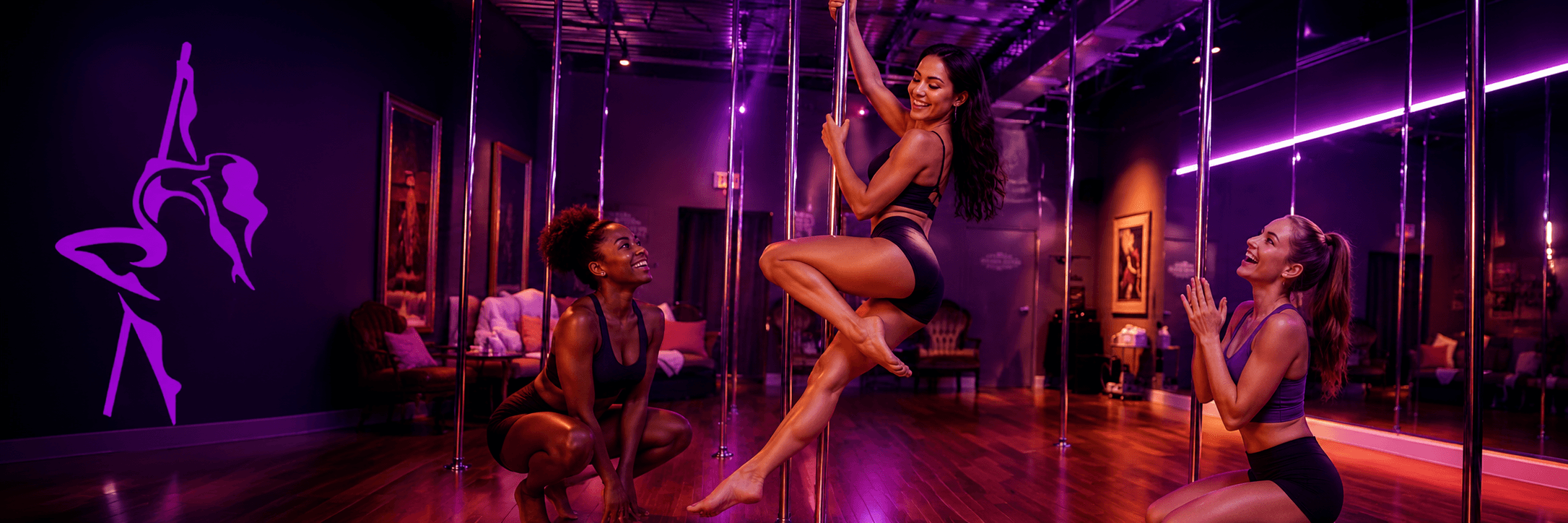
This is where the conversation gets interesting. Pole fitness — and yes, we mean actual pole dancing taught in a real studio setting — addresses every gap that barre and pilates leave behind. And it does it in a way that is genuinely, deeply fun.
On the pole, your upper body carries real load. Every climb, hold, and transition requires your grip, forearms, biceps, shoulders, and back to work together under meaningful resistance — your own bodyweight. That's progressive overload built right into the workout. Women who add pole to their routine almost always notice arm and back definition within weeks, not months. Your core engagement on the pole is also significantly more demanding than what you experience in either barre or pilates, because you're stabilizing a moving, rotating body rather than a static one.
And the lower body? Pole works that too. Splits training, floorwork, and transitions between moves develop hip flexor flexibility, inner thigh strength, and glute activation in ways that complement barre beautifully.
The result is a truly full body workout that hits upper body strength, deep core stability, lower body tone, flexibility, and coordination all at once. If you're curious about what a first class actually looks like, this guide to your first pole dancing class walks you through everything so there are no surprises.
HOW TO BUILD A ROUTINE THAT ACTUALLY COVERS EVERYTHING
You don't have to choose between barre, pilates, and pole. Many women at Intice Dance Fitness in St. Petersburg blend all three into a weekly rotation that covers every base. Here's what a smart weekly split might look like:
Two days of pilates for core depth and posture work. One day of barre for lower body endurance and that focused burn. Two days of pole fitness for upper body strength, full body integration, and the kind of joy that keeps you actually showing up. That's five days of movement that complements itself beautifully, never repeats the same stimulus, and builds a body that looks and feels strong from every angle.
If you're ready to explore what pole can add to your current routine, check the class schedule and find a beginner-friendly session that works for your week. You can start with a single class and go from there.
KEY TAKEAWAY: Barre and pilates are both excellent — but neither delivers the upper body strength and full body integration that pole fitness provides. Adding pole to your routine closes the gap and makes your workouts dramatically more effective and more fun.
If you've been searching for the missing piece in your fitness routine, we'd love to show you what pole can do. Come try a class at Intice Dance Fitness in St. Pete and experience full body toning that actually excites you.
FAQ
Q: Is pole fitness appropriate for women who already do barre or pilates?
A: Absolutely — in fact, the body awareness and core control you build in barre and pilates translate directly to pole. Many women find that their existing training gives them a head start when they begin pole classes.
Q: Will I need upper body strength before my first pole class?
A: No prior upper body strength is required. Beginner pole classes are designed to build your strength progressively as you learn, starting with foundational moves that are accessible to all fitness levels.
Q: How quickly will I see toning results from pole fitness?
A: Most women notice improved upper body definition and core engagement within four to six weeks of consistent classes. Because pole uses your full bodyweight as resistance, the stimulus for change is significant right from the beginning.
You Might Also Like