
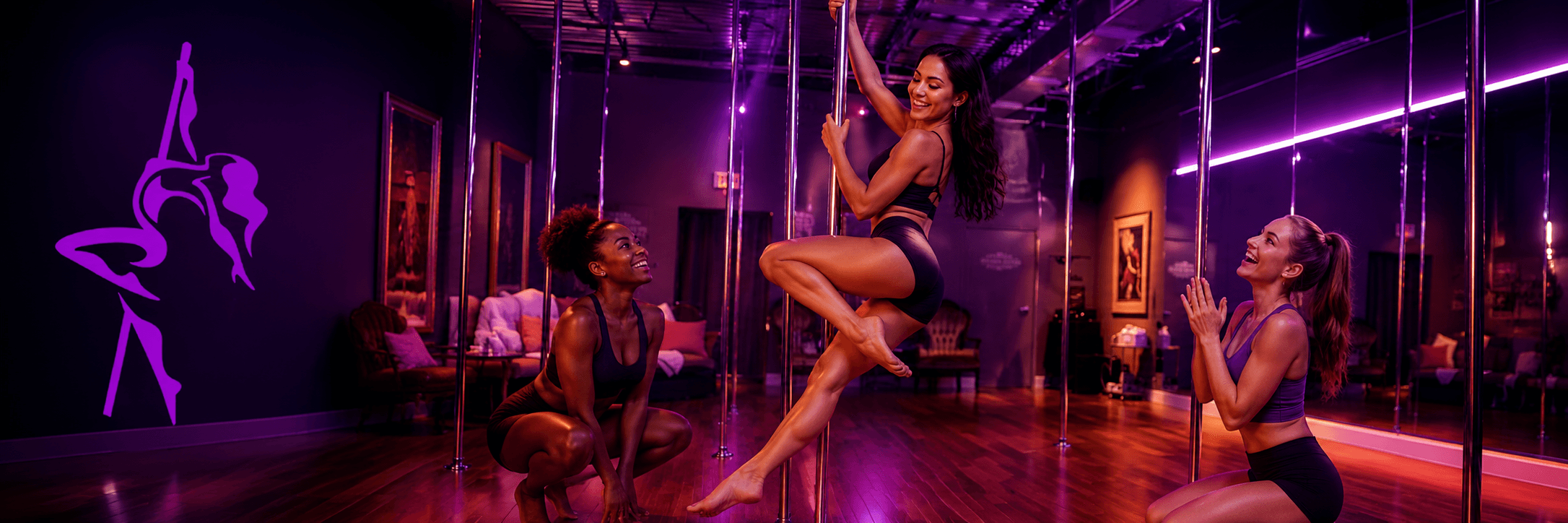
What Is a Brass Monkey Pole Move? 6 Things to Know
What is a brass monkey pole move? An instructor explains what it looks like, what level it is, and why it must be learned in class.
A brass monkey is an advanced inverted pole move in which the dancer hangs upside down at the side of the pole, held by one hooked knee and a strong upper-body grip, with her body angled away from the pole like a flag. If you are asking what is a brass monkey pole move in November 2026 because one stopped your scroll, you are in good company. It is one of the most striking shapes in pole, and it belongs firmly in the advanced category. Here are six things I want every curious student to know about it.
WHAT IS A BRASS MONKEY POLE MOVE
1. It is an inverted hold, not a spin.
The brass monkey is a position the dancer arrives in and holds while upside down. Her hips are above her head, one knee is hooked around the pole, and her arms and upper body are wrapped close to the pole to keep her there. It often appears as one link in a longer chain of inverted moves rather than on its own.
2. The shape reads as a sideways flag.
In most inverted leg hangs, the dancer's body sits in line with the pole. In a brass monkey, her body is offset to one side. The hooked knee is the anchor point, the torso angles out, and the free leg can extend or bend to create different lines. That offset is why it looks as though she is floating beside the pole rather than hanging from it.
You may see small differences in arm position and leg styling from dancer to dancer. Terminology and variations differ a little between studios, so your instructor's version is the one to follow.
WHAT LEVEL IS IT AND WHAT COMES BEFORE IT
3. It is an advanced move with a long list of prerequisites.
Generally speaking, the brass monkey sits well past the beginner and early intermediate stages. Before working toward it, a dancer typically has all of the following in place:
- A controlled invert that does not rely on jumping or kicking
- Solid, confident inverted leg hangs on both sides
- Strong, reliable grip
- Stable shoulders that can support her weight upside down
- Comfort being inverted, and the ability to stay calm and think clearly there
- A practiced way of exiting inverted positions with control
Every studio structures its curriculum a little differently, so I will not give you an official rating. Ask your instructor where this move falls in our Level 1 through Level 3+ progression and which foundations she wants to see from you first.
None of this means it is out of reach for someone starting from zero. It means there is a real path to walk first, and that path of spins, climbs, sits, and conditioning is where most of the fun happens anyway.
WHAT DOES IT BUILD IN YOUR BODY
4. It trains grip, shoulders, core, and nerve all at once.
Holding your body out to the side of the pole asks a lot of you:
- Your hands and forearms work hard to keep you secure.
- Your shoulders and upper back have to stay active and engaged rather than hanging passively.
- Your core, especially the muscles along your sides, holds the angled shape.
- The hooked leg squeezes with purpose the whole time.
Grip in particular develops gradually with consistent practice. A small observational study of 52 fitness pole dancers found that hand-grip strength and postural stability increased significantly with pole dance experience level. If you want to understand how that strength gets built from the first class onward, our post on upper body strength for pole explains it in more detail.
There is also a mental side. Being upside down and off-center takes body awareness and trust in your own training. Dancers love this move partly for how it looks and partly for what it represents: proof of patient work.
WHAT DO PEOPLE GET WRONG ABOUT IT
5. Several common beliefs about it are wrong.
Misconception: it is mostly a leg move. The hooked knee is the most visible part, but the upper body is doing a great deal of the holding. Dancers who underestimate the shoulder and grip demand are the ones who get into trouble.
Misconception: if you can invert, you are ready. Inverting is a starting point for this family of moves, not a finish line. Readiness is something an instructor assesses by watching you move, and it differs from person to person.
Misconception: a video shows you everything you need. A clip shows the finished shape from one angle. It does not show the conditioning behind it, the hands of a spotter just out of frame, or the many supervised attempts that came before.
Misconception: discomfort means you are doing it wrong. Skin contact is what holds you on the pole, so skin discomfort and light bruising, often called pole kisses, are common when learning new contact points. Sharp pain is different. If you feel sharp pain in any move, stop and tell your instructor.
HOW IS IT LEARNED SAFELY IN A CLASS
6. It is learned in person, with a spotter and a mat, and no other way.
I am deliberately not giving you steps for this move. A brass monkey must be learned in person with a qualified instructor, with hands-on spotting and crash mats. It should never be attempted alone or at home. A fall from an inverted position can cause serious injury, and no written description can stand in for a trained set of eyes and hands.
At Intice Dance Fitness in St. Petersburg, advanced inverted work is approached through progression. An instructor confirms your foundations, uses preparatory drills, spots you closely, and decides with you when it is time to try the full shape. You can see how our classes and levels are organized to get a sense of that path.
If you have an injury or a medical condition, check with your doctor before starting pole. An article cannot tell you whether a particular move is safe for you personally.
KEY TAKEAWAY: The brass monkey is an advanced inverted hold that depends on grip, shoulder stability, and well-practiced inverts. It is learned safely only in class, with a qualified instructor, spotting, and crash mats.
If this move has caught your imagination, the best first step is a beginner class where we can start building your foundations together. Take a look at the class schedule and come meet us. Drop-ins are always welcome and no experience is needed.
FAQ
Q: Can I try a brass monkey at home if I have a pole?
A: No. This is an advanced inverted move, and it should be learned in class first with a qualified instructor, hands-on spotting, and crash mats. Practicing it alone or at home carries a real risk of serious injury.
Q: I am a complete beginner. Could I ever work toward a brass monkey?
A: Many dancers who now perform advanced moves started with no experience, but nobody can promise a specific move or a timeline. At Intice Dance Fitness in St. Petersburg, new students begin with foundations such as spins, climbs, and conditioning. Your instructor can tell you which skills she wants to see before any inverted work.
Q: Does a brass monkey hurt?
A: Skin discomfort and light bruising, known as pole kisses, are common when learning new contact points on the pole, and they usually ease as your skin adapts. Sharp pain is not something to push through, so stop right away and tell your instructor. If you have an injury or a medical condition, check with a doctor before you start.
You Might Also Like