
What Is a Chair Spin in Pole Dancing? Myths Busted
What is a chair spin in pole dancing? An instructor explains this classic beginner spin, busts three common myths, and shares how it is learned safely.
A chair spin is a beginner pole spin where you hold the pole with both hands, lift both legs off the floor with your knees bent as if you were sitting in an invisible chair, and rotate around the pole. If you have been searching what is a chair spin in pole dancing after seeing it on social media this October 2026, you are looking at one of the first spins most new students meet. It looks simple and tidy, which is exactly why it collects so many misconceptions. Let's clear up the three I hear most often in first classes.
WHAT IS A CHAIR SPIN IN POLE DANCING
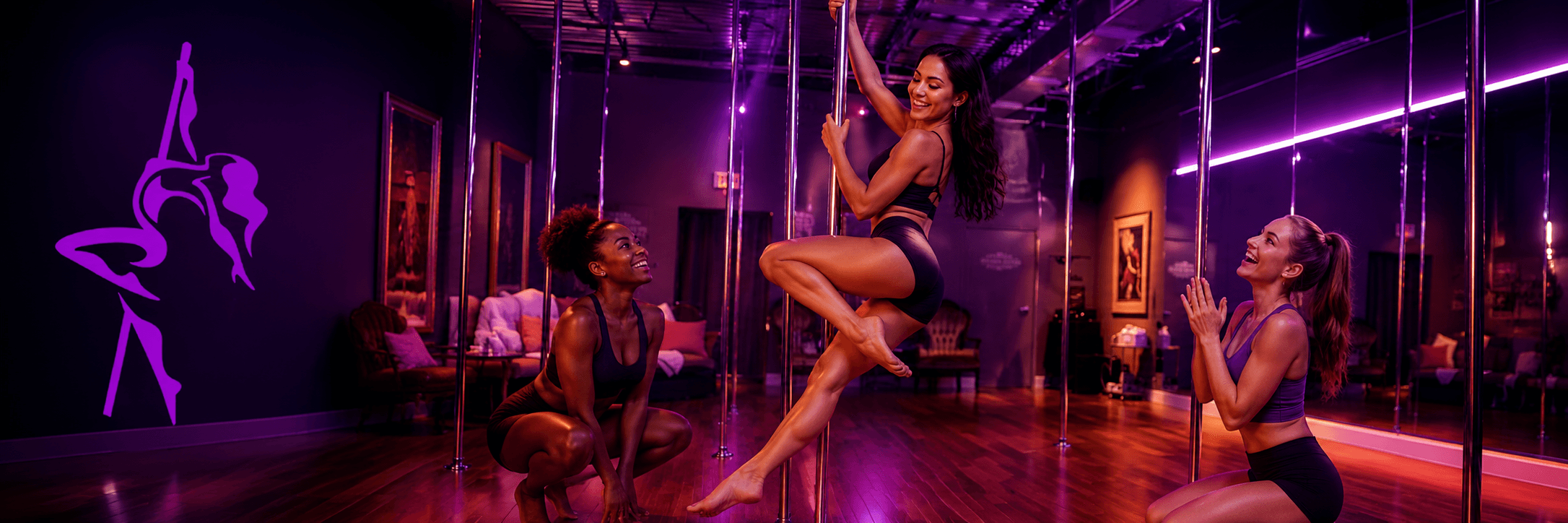
Picture a dancer standing beside the pole, taking a few steps to build momentum, then stepping in and gripping the pole with one hand above the other. In the same moment, both knees draw up and together in front of the body, thighs roughly parallel to the floor, feet pointed. The body travels around the pole in a seated shape, then the feet come back down to a controlled landing.
What makes it a "chair" is the seated silhouette. The knees stay bent and close, the chest stays lifted, and the dancer looks like she is perched on a stool that happens to be rotating. On a static pole, the spin comes from the momentum of the walk-in. On a spin pole, the pole itself rotates and the shape is held for longer.
It is a cousin of the fireman spin, but it is its own move with its own grip and leg position, so I will leave the fireman for another day.
IS THE CHAIR SPIN REALLY A BEGINNER MOVE
Yes, in general terms the chair spin sits firmly in beginner territory. It is usually introduced after a student has learned how to walk around the pole with intention, how to grip with engaged shoulders rather than hanging off the joints, and how to land on her feet with control. Ask your instructor where it falls in the Level 1 through Level 3+ progression, because every studio sequences spins a little differently.
Even as a beginner spin, it is doing real work. The chair spin trains grip endurance, shoulder engagement, core control to hold the legs up, and the coordination of timing a step with a grip and a lift all at once. It also builds something less tangible: the confidence of leaving the floor for the first time and trusting that the pole will hold you.
MYTH ONE IS A CHAIR SPIN JUST ARM STRENGTH
The most common thing I hear is some version of "I don't have the arms for that." Beginners watch a chair spin and assume the dancer is muscling her entire body weight through her biceps.
The reality is that a well-executed chair spin runs on momentum and structure, not brute pulling. The walk-in creates the rotation. The shoulders are drawn down and back, so the weight hangs from engaged muscle around the shoulder girdle instead of from the elbow or wrist joints. The core lifts the knees, and the arms mainly hold a stable frame. Students who try to yank themselves around usually stall, tire fast, and feel it in their forearms the next day.
Form cues an instructor will give you: keep your shoulders away from your ears, let the top arm stay long and strong, keep the knees pressed gently together, and look in the direction you are traveling. Those cues matter far more than how much you can curl.
MYTH TWO AM I DOING IT WRONG IF I ONLY SPIN HALFWAY
New students often stop a quarter or half of the way around, feet touching down early, and immediately apologize. They assume a full rotation is the only "real" chair spin.
Not true. On a static pole, how far you travel depends almost entirely on the momentum you generate before your feet leave the ground, and that timing is a skill that develops through repetition. Short spins are the normal starting point, not a failure. Many instructors would rather see a half rotation with great shape and a soft landing than a full rotation with collapsed shoulders and a thud.
What I correct instead is the shape. Are the knees lifted together or has one dropped? Is the chest tall or folding toward the pole? Did the feet land under the body? Fix the shape first, and the distance follows as your confidence and timing improve. For a sense of how first-class learning actually feels, read what to expect at your first pole dancing class.
MYTH THREE DO I NEED TO BE STRONG BEFORE I TRY IT
Some beginners put off their first class entirely, planning to "get strong first" and then learn spins. In my experience, this gets the order backward. Beginner spins like the chair are one of the ways grip and shoulder strength get built in the first place. You do not arrive strong; you become strong by practicing scaled, well-coached versions of moves like this one.
The research points the same direction. A study of 52 fitness pole dancers found that hand-grip strength and postural stability increased significantly with pole dance experience level, and the authors concluded regular practice can contribute to a significant increase in strength and improved postural stability. It was a small, observational study, so treat it as a signal rather than a guarantee. But it matches what I watch happen on the studio floor week after week.
Be prepared for a few normal sensations along the way. Skin discomfort and light bruising, which dancers call pole kisses, are common early on where the inner knees or hands meet the pole. That is different from sharp pain. If anything feels sharp or wrong, stop and tell your instructor. If you have an injury or medical condition, check with your doctor before starting pole at all.
HOW IS A CHAIR SPIN TAUGHT SAFELY IN CLASS
At Intice in St. Petersburg, the chair spin is never the first thing you do when you walk in. Class opens with a warm-up that wakes up the shoulders, wrists, and core. The instructor then breaks the spin into pieces: the walk, the grip, the knee lift, and the landing, practiced separately before they are combined. You will try it on both sides, because the pole does not care which hand you write with.
Most students are spinning on their own within their first one to two classes, and your instructor is beside you the whole time, watching your grip and correcting your shoulders before a bad habit sets in. If you want focused time on this one move, private lessons give you an instructor's full attention. Skin contact is your grip, so come in form-fitting shorts and a sports top, bare feet, no jewelry, and no lotion on class day.
A video cannot see your shoulders drop or your knees separate. A coach can.
KEY TAKEAWAY: The chair spin is a beginner seated-shape spin powered by momentum and shoulder engagement rather than raw arm strength, and short rotations are a normal starting point. It is learned safely in class, with an instructor correcting your form in real time.
Ready to feel your feet leave the floor for the first time? Check the schedule, book a class, and let an instructor walk you through your first chair spin step by step. New students can try two weeks of unlimited classes for $59.
FAQ
Q: Can I teach myself a chair spin at home from a video?
A: I recommend learning it in class first. A video cannot tell you when your shoulders are collapsing, your grip is sliding, or your landing is unsafe, and those are exactly the details that lead to strains and falls. Once an instructor has watched you do it correctly, you will know what the right version feels like.
Q: Does the chair spin hurt?
A: Light skin discomfort on the hands and sometimes the inner knees is common when you are new, and mild bruising or pole kisses can show up as your skin adjusts. Sharp pain in a joint is not normal, and you should stop and tell your instructor right away. Anyone with an injury or medical condition should speak with a doctor before starting.
Q: Where can I learn a chair spin in St. Petersburg?
A: Intice teaches beginner spins to brand-new students at its studio at 2104 34th St S, in the same plaza as Domino's Pizza at the opposite end, and drop-ins are welcome with no experience needed. Levels run from Level 1 through Level 3+, and your instructor can tell you where the chair spin fits in your progression. Check the schedule page for actual class times.
You Might Also Like