
Fitness Classes That Improve Posture and Core Strength for Women: What You Need to Know
Think crunches and planks are your only path to better posture and core strength? Think again. Here's what actually works.
If you've been searching for fitness classes that improve posture and core strength in June 2026, there's a good chance you've already tried the usual suspects — yoga, pilates, maybe a barre class or two. And while those options have their place, there are some surprisingly stubborn myths floating around about what actually builds a strong, upright, pain-free body. Let's clear them up, because the truth might lead you somewhere you never expected.
MYTH 1: CORE STRENGTH IS ALL ABOUT YOUR ABS
This is one of the most common misconceptions women carry into their fitness journey, and it quietly sabotages results for years. Core strength is not about getting a flat stomach or doing hundreds of crunches. Your core is a full system of muscles that wraps around your entire midsection — front, back, and sides — including your deep stabilizers, your pelvic floor, your obliques, and the muscles along your spine.
When you train only the superficial muscles (hello, crunches), you leave those deeper stabilizers weak and untrained. That's actually one of the leading reasons women develop poor posture and chronic lower back pain. According to the American Council on Exercise, effective core training must include exercises that challenge stability, balance, and multi-directional movement — not just isolated ab work. The classes that do this best are ones that require your body to stay upright, control momentum, and engage through the entire trunk simultaneously. Think about that the next time you're deciding between a crunch circuit and something more dynamic.
MYTH 2: PILATES AND YOGA ARE THE GOLD STANDARD FOR POSTURE
Pilates and yoga are genuinely wonderful. No one is taking that away. But they are not the only — or even necessarily the best — path to improved posture and a stronger core for every woman. The belief that these are the only "elegant" or "serious" options for postural work has caused a lot of women to overlook fitness formats that are arguably more effective at building the kind of functional, integrated strength that keeps you tall and confident.
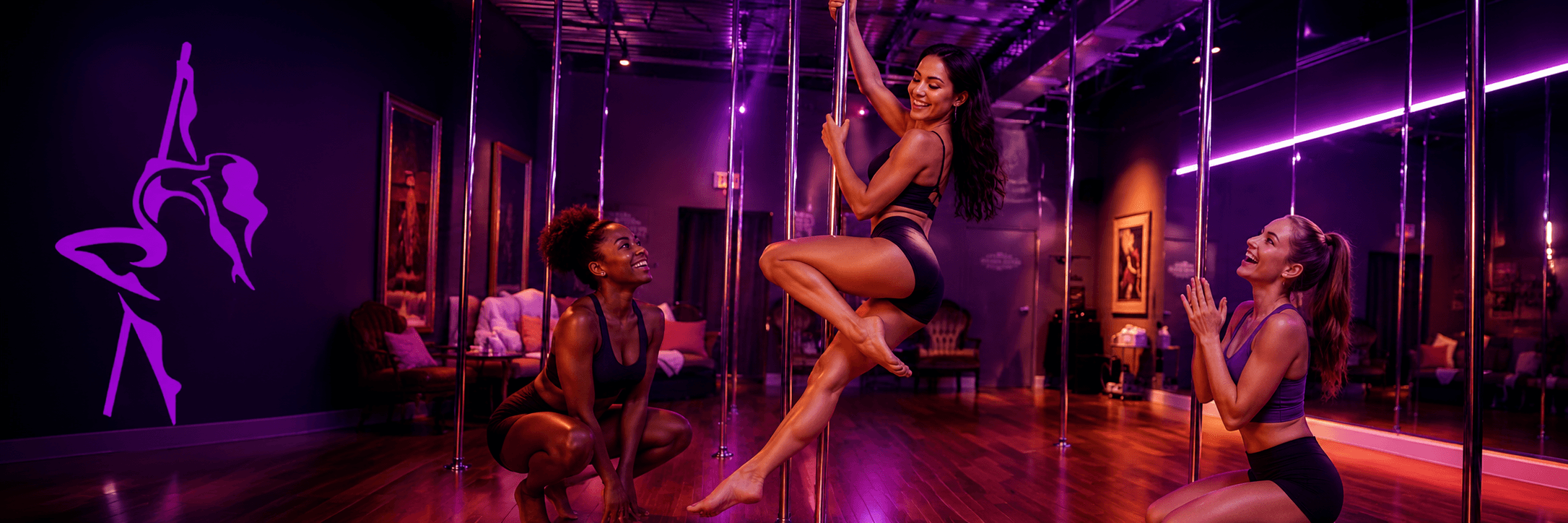
Pole dancing, for example, is one of the most demanding core and upper body disciplines you can train. Every climb, every hold, every spin requires your body to brace, stabilize, and move with control. Your lats, rhomboids, and deep spinal muscles — the exact muscles responsible for upright posture — get trained in ways that mat-based classes simply cannot replicate. If you've been curious, here's a great breakdown of what to expect at your first pole dancing class so you know exactly what you're walking into.
MYTH 3: YOU NEED TO BE STRONG ALREADY TO START SOMETHING LIKE POLE
This might be the myth that keeps the most women stuck. The assumption that you need a baseline of strength before you can try a class that builds strength is circular thinking that keeps you in your comfort zone indefinitely. The truth is that structured, progressive pole dance instruction is designed to meet you exactly where you are. Beginner classes are built around foundational movements that develop grip, shoulder stability, core engagement, and spinal alignment from the ground up. You do not need to walk in already strong. That's the whole point.
The women who show up to beginner pole classes at Intice Dance Fitness in St. Petersburg, FL are not athletes. They're women who were bored with their current routine, frustrated with workouts that weren't producing results, or simply looking for something that felt exciting instead of obligatory. Many of them report noticeable improvements in posture, shoulder pain, and core awareness within just a few weeks — not months. The format forces your body to engage muscles you've been ignoring, and it does it in a way that actually feels good.
WHAT TO LOOK FOR IN A CLASS THAT DELIVERS REAL RESULTS
Not all fitness classes are created equal when it comes to postural improvement and core development. Here's what separates the ones that work from the ones that feel productive but don't actually change your body over time.
First, look for classes that involve vertical pulling movements. Pulling your body upward — whether on a pole, rings, or suspension trainer — recruits the back muscles that are almost always underdeveloped in women who sit at desks or spend time hunched over phones. These are the muscles that pull your shoulders back and keep your spine long.
Second, look for classes that require balance and body awareness. When your nervous system has to work to keep you stable, you're training the deep stabilizers that no crunch will ever reach. This is where the postural magic happens.
Third, look for a structured progression. A class that challenges you week over week, introducing new skills as your body adapts, will produce compounding results. That's exactly how the class offerings at Intice Dance Fitness are designed — so your strength, posture, and confidence build together over time.
If you're not sure where to start or want to explore whether private instruction might be the right entry point for you, that option is available too. One-on-one attention is one of the fastest ways to correct movement patterns and build a strong foundation.
KEY TAKEAWAY: Pole dancing is one of the most effective and underrated fitness formats for improving posture and core strength in women — and you don't need to be strong or experienced to start.
If you're ready to experience a workout that actually changes how you stand, move, and feel in your body, Intice Dance Fitness in St. Petersburg is the place to start. Check the schedule and book your first class — your posture will thank you by next month.
FAQ
Q: Is pole dancing actually effective for improving posture?
A: Yes, and it's one of the most effective formats available. Pole training heavily recruits the back, shoulder, and deep spinal muscles that directly support upright posture. Most students notice improvements in how they carry themselves within the first few weeks of consistent practice.
Q: Do I need prior fitness experience to join a beginner pole class?
A: No prior experience or fitness level is required. Beginner classes are designed to build strength progressively from your very first session. Instructors guide you through foundational movements that are safe, structured, and appropriate for all starting points.
Q: How often should I attend class to see results in core strength and posture?
A: Most women see meaningful changes with two to three classes per week. Consistency matters more than intensity at the beginning. Even one class per week will begin to activate muscles that typical gym workouts leave untouched, and results build from there.
You Might Also Like