
I Stopped Seeing Results at the Gym — What Should I Try Instead?
Hitting a wall at the gym? Here are the questions to ask yourself and the fresh approach that could finally get you moving forward again.
If you've been staring at the same weight machines, running the same treadmill loop, and wondering why your body stopped responding sometime around this July 2026, you're not imagining it. Plenty of women in St. Pete hit a point where the gym that once felt exciting starts to feel like a chore that gives nothing back. Before you write yourself off as "unmotivated" or double down on a routine that isn't working, let's answer the three questions almost everyone asks when the results dry up.
WHY DID MY RESULTS STOP IN THE FIRST PLACE?
The most common reason isn't laziness or age — it's adaptation and boredom. Your body is brilliant at getting efficient at whatever you repeat. The same circuit that transformed you six months ago is now something your muscles can do in their sleep, which means less stimulus and fewer results. On top of that, when a workout stops being interesting, you show up less often, push a little less hard, and skip the "extra" set. The physical plateau and the motivation plateau feed each other.
Here's the part most people miss: how much you enjoy your workout isn't a luxury — it's actually one of the strongest predictors of whether you'll keep doing it long enough to see change. Research using a validated motivation measurement tool found that long-term exercise adherence was associated with enjoyment, competence, and social motives, not motives focused purely on fitness or appearance, according to a study on Intrinsic motivation and exercise adherence. In other words, if you dread the gym, the odds are stacked against you from the start — no matter how "correct" your program is on paper.
SHOULD I JUST WORK HARDER, OR DO SOMETHING DIFFERENT?
The instinct is to grind harder — more cardio, more reps, more days. Sometimes that helps briefly, but if the real problem is that your body has adapted and your motivation has flatlined, adding more of the same thing usually just accelerates burnout. What actually breaks a plateau is a genuinely new stimulus: movements your body has never had to figure out, muscles that haven't been challenged in this specific way, and a format that pulls you in instead of pushing you out the door.
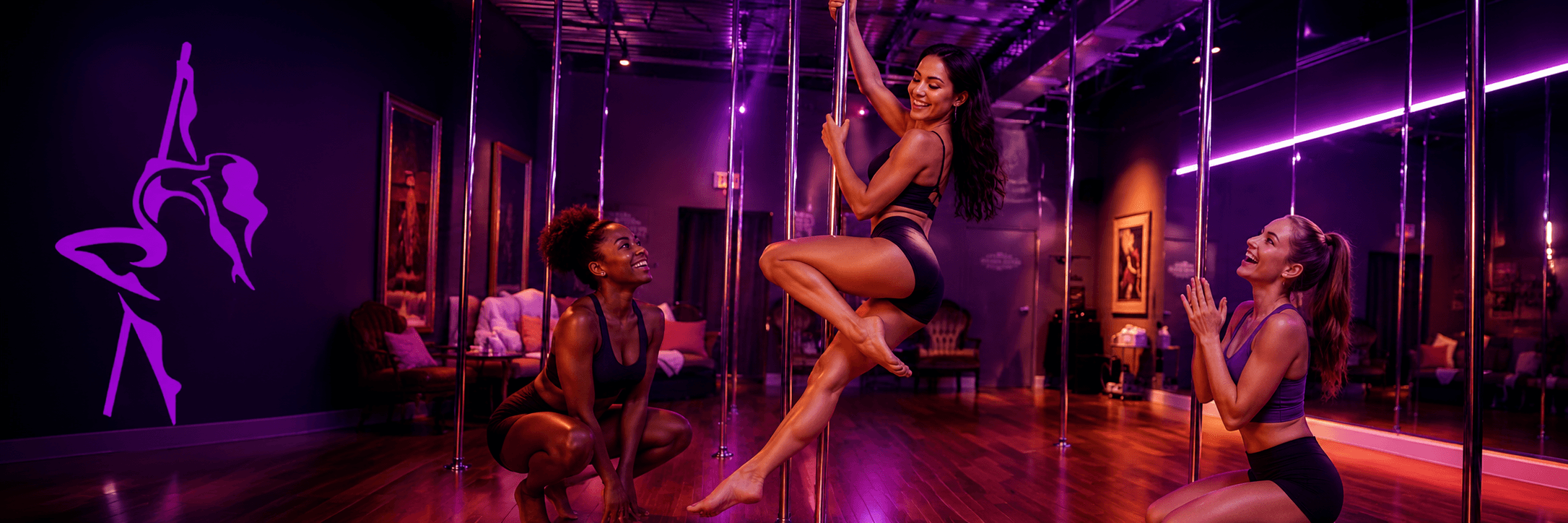
This is exactly why so many women who felt stuck at a traditional gym find their spark again with pole and dance fitness. Pole demands full-body strength, grip, coordination, and control in patterns your body has almost certainly never trained. You're pulling, climbing, holding your own bodyweight, and learning choreography — which means your muscles, your balance, and your brain all get a fresh challenge at once. The plateau breaks because the input finally changed. If you're curious what that actually looks like, our overview of class types and offerings shows just how different this is from another set of bicep curls.
WHAT MAKES POLE AND DANCE FITNESS DIFFERENT FROM THE GYM?
Three things, mostly.
First, it's skill-based. At the gym, "progress" is an abstract number on a scale. In pole, progress is visible and specific — the first time you climb, your first spin, the inversion you couldn't do last month. That sense of building competence is deeply motivating and keeps you coming back, which is the whole point.
Second, it's a community, not a room full of strangers with earbuds in. You're learning alongside other women who cheer for your wins. That social energy is one of the exact motives research links to sticking with exercise long-term. Many women tell us the encouragement in class is the reason they finally stayed consistent after years of quitting gym memberships. You can feel that atmosphere the moment you walk into the studio. Third, it doesn't feel like punishment. You're moving to music, expressing yourself, and genuinely having fun — and you happen to build serious strength while doing it. If you've been curious but nervous, our guide on what to expect at your first pole dancing class walks you through it so nothing feels like a mystery on day one.
HOW DO I ACTUALLY MAKE THE SWITCH WITHOUT WASTING MONEY?
You don't have to blow up your entire routine overnight. Start by carving out one or two days a week for something new and see how your body and your mood respond. Most women notice the difference in energy and enthusiasm long before they notice it in the mirror.
Practically, that looks like trying a beginner-friendly class first rather than committing to a long contract. A single drop-in or a small class pack lets you test the waters without pressure. If you fall in love with it — and most people do — you can move into a membership once you know it's the right fit. Wear something you can move in, come with an open mind, and give yourself permission to be a beginner again. That beginner's excitement is exactly the ingredient your stalled routine has been missing.
The bigger mindset shift is this: you are not broken, and you didn't fail at fitness. You simply outgrew a routine that stopped serving you. The gym is one tool among many, and it's not the right one for everyone at every stage. When results stop, that's not a signal to try harder at the same thing — it's an invitation to try something that lights you up.
KEY TAKEAWAY: When results stall, the fix usually isn't more of the same workout — it's a genuinely new, enjoyable challenge, and pole and dance fitness deliver both the fresh physical stimulus and the enjoyment that keeps you consistent.
Ready to feel excited about moving your body again? Come book a class at Intice Dance Fitness in St. Petersburg and rediscover what real progress feels like. We'll be cheering you on from your very first spin.
FAQ
Q: I'm not strong or flexible — can I really start pole after being stuck at the gym?
A: Absolutely. Beginner classes are designed to build your strength and flexibility gradually, so you start exactly where you are today. Most women are surprised how quickly they progress once they're doing movements they actually enjoy.
Q: How often should I take pole classes to break my plateau?
A: Starting with one to two classes a week is plenty to introduce a new stimulus and jumpstart progress. As you build confidence and competence, many women naturally add more sessions because they look forward to coming, not because they feel obligated.
Q: Do I need to quit the gym completely to try this?
A: Not at all. Many of our members keep some gym training and add pole and dance fitness for the fresh challenge, community, and fun. The key is giving your body a new kind of movement so it has a reason to adapt again.
You Might Also Like