
I Stopped Seeing Results at the Gym — What Should I Try Instead? A Step-by-Step Plan
Stopped seeing results at the gym? Follow this step-by-step plan to break your plateau and find a workout you'll actually love in St. Pete.
If you've caught yourself thinking, "I stopped seeing results at the gym — what should I try instead?" this August 2026, you're not broken and you're not lazy. You've simply hit the wall that almost every dedicated gym-goer eventually hits: the plateau. You show up, you do your circuits, you log your cardio minutes, and yet the mirror, the scale, and your energy levels all seem frozen in place. The good news? A plateau isn't a signal to push harder at the same thing. It's a signal to change the thing entirely. Here's a step-by-step plan to break through — and why so many women in St. Petersburg are finding their answer somewhere they never expected: a pole dance fitness studio.
STEP 1 ACCEPT THAT YOUR BODY HAS ADAPTED
The first step is understanding why your results stalled in the first place. Your body is brilliant at adaptation. When you repeat the same treadmill session, the same machine circuit, or the same group class week after week, your muscles and nervous system become efficient at it. Efficiency is great for survival — and terrible for progress. The workout that transformed you six months ago now barely registers as a challenge.
This is why "more of the same" almost never fixes a plateau. Adding ten more minutes of cardio or one more set of the same exercise is just asking an adapted body to do slightly more of what it already knows. What your body actually craves is novelty: new movement patterns, new muscle recruitment, new skills it has never had to figure out before.
STEP 2 AUDIT YOUR MOTIVATION NOT JUST YOUR WORKOUT
Here's the part most plateau advice skips entirely: results don't just stall because of programming. They stall because of motivation. When a workout becomes boring, you unconsciously dial down your intensity, skip sessions more easily, and stop pushing into the discomfort where change actually happens.
The research backs this up. A population study of fitness center members found that people exercising for enjoyment and stress relief were more often associated with self-directed or class-based activity, while appearance-focused motives were more associated with other exercise formats — suggesting the format of a workout genuinely shapes whether people stick with it, according to Motivational variations in fitness: a population study of exercise modalities, gender and relationship status.
So ask yourself honestly: when was the last time you were excited to work out? If your answer involves squinting into the distant past, your plateau isn't just physical. It's motivational — and that's actually the easier problem to solve.
STEP 3 REPLACE REPETITION WITH SKILL-BASED MOVEMENT
This is where pole dance fitness changes the game. Unlike a machine circuit, pole is a skill-based practice. Every class asks your body to solve a new puzzle: a spin, a climb, a transition, a hold. You're not counting reps until a timer goes off. You're learning something — and skill-based movement is uniquely plateau-resistant because there is always a next level.
Physically, pole delivers what most gym routines quietly neglect. It builds serious grip, upper body, and core strength through full-body bodyweight work. It trains flexibility and coordination alongside strength instead of treating them as separate boxes to check. And because you're constantly progressing to new moves, your body never gets the chance to settle into that efficient, results-killing groove.
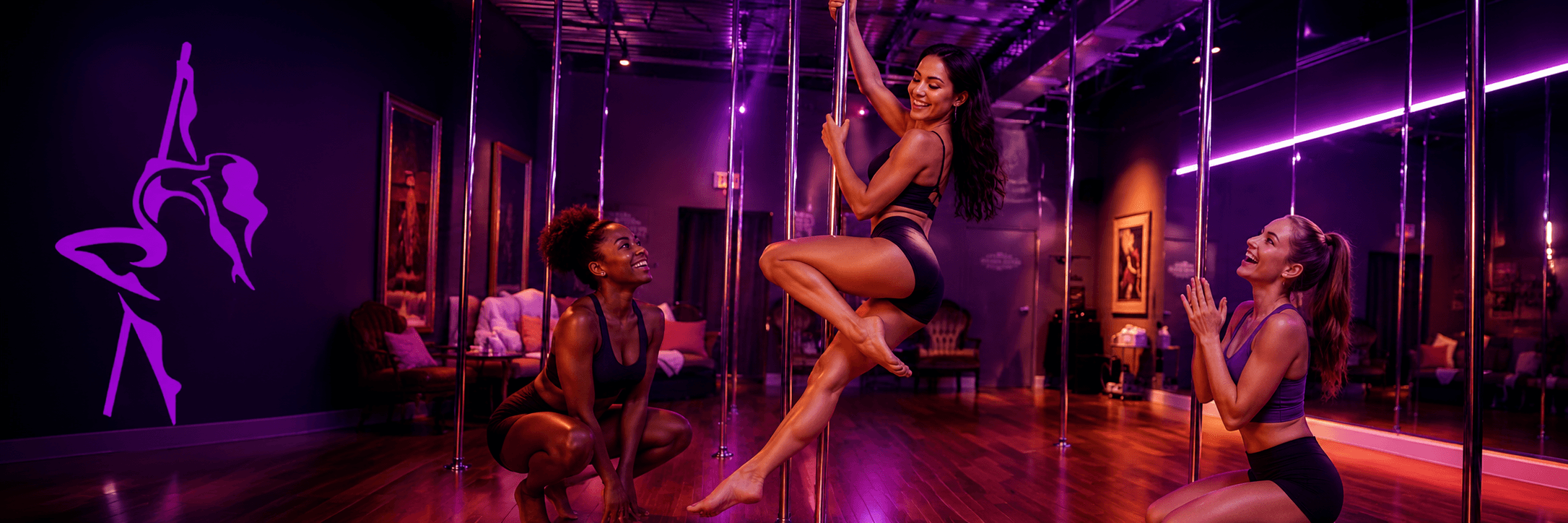
At Intice Dance Fitness in St. Petersburg, we see this transformation constantly. Women arrive frustrated after months or years of stalled gym progress, and within weeks they're noticing muscle definition in their arms, shoulders, and core that traditional training never delivered — not because pole is magic, but because it's genuinely new to their bodies.
STEP 4 CHOOSE A FORMAT YOU WILL ACTUALLY LOOK FORWARD TO
Breaking a plateau isn't a two-week project. It requires consistency over months, and consistency requires enjoyment. This is the step where you stop choosing workouts based on what you think you should do and start choosing based on what you'll actually keep doing.
Pole fitness has a built-in advantage here: it's fun in a way that's hard to explain until you've tried it. There's music, community, laughter, and the unbeatable rush of nailing a move you couldn't do last month. Classes are structured for absolute beginners, so you don't need dance experience, existing upper body strength, or a specific body type to start. If you're curious what a class actually looks like, our range of class offerings covers everything from first-timer fundamentals to conditioning and flexibility, and this guide to fun workout classes in St. Petersburg breaks down why enjoyment is the missing ingredient in most fitness routines.
STEP 5 COMMIT TO A REAL TRIAL PERIOD
The final step: give your new approach a fair shot. One class tells you whether you enjoyed it. Six to eight weeks tells you whether it works. Commit to two classes per week for two months, track how you feel — strength, energy, mood, confidence — and let the results speak.
Most women who make this switch report something surprising: the physical changes almost become secondary. They walk taller. They feel stronger opening jars, carrying groceries, holding a plank. They stop dreading workouts and start scheduling their week around them. That shift — from obligation to anticipation — is what finally breaks the plateau for good.
KEY TAKEAWAY: A fitness plateau means your body has adapted and your motivation has faded — and the fix is not more of the same workout, but a completely new, skill-based challenge you genuinely enjoy. Pole dance fitness delivers both the novelty your body needs and the fun your consistency depends on.
If you're done spinning your wheels at the gym, come see what a plateau-proof workout feels like at Intice Dance Fitness in St. Petersburg. Check out our class schedule and book your first class today — your future stronger self is already waiting.
FAQ
Q: Do I need to be strong or flexible to start pole fitness after leaving the gym?
A: Not at all. Beginner classes are designed to build strength and flexibility from wherever you are right now, and any gym background you have will actually give you a head start. The pole itself becomes your training tool, so you develop the strength as you learn.
Q: How long before I see results from switching to pole dance fitness?
A: Most women notice improved grip and upper body strength within the first few weeks, with visible muscle definition typically following over the next couple of months of consistent classes. Because every class introduces new skills, progress tends to feel continuous rather than stalling out.
Q: Can I do pole fitness alongside my existing gym routine?
A: Absolutely — many of our students use pole as their primary strength and skill work while keeping gym sessions for cardio or accessory training. Just allow rest days between intense pole classes at first, since pole works muscles most gym routines miss.
You Might Also Like