
Pole Dancing vs Barre for Full Body Strength | St. Pete
Pole dancing vs barre for full body strength: an honest comparison for Tampa Bay women deciding which workout actually builds strength that lasts.
You have probably scrolled past both by now. The barre studio with its ballet-pink branding, and the pole studio you keep telling yourself is for other women. It is August 2026, you are tired of workouts that never seem to change anything, and somewhere in the back of your mind you are weighing pole against barre and wondering which one would actually make you stronger, everywhere, not just sore in one spot. Plenty of women across Tampa Bay are asking the same question, and the honest answer is more interesting than either studio's marketing suggests.
Here is a fair, side-by-side look from someone who has taught hundreds of first pole classes to women who had never done either.
WHY BARRE FEELS SAFE AND POLE FEELS SCARY
Barre feels approachable because it looks like something you are allowed to do. Small movements, socks on, a bar to hold, nobody upside down. Pole feels like it belongs to women who are already fit, already flexible, already confident.
That instinct is understandable, but it is backwards in one important way. Barre assumes you can hold positions for long stretches from day one. Pole assumes nothing. A Level 1 class starts with walking, posture, and basic spins, and most students at Intice are spinning on their own within their first one or two classes. Nobody hands you an inversion on day one. You earn strength gradually, which is exactly why it works for women starting from zero.
WHAT BARRE ACTUALLY DOES FOR YOUR BODY
Barre deserves genuine credit. It is low-impact, gentle on joints, and excellent at building muscular endurance in the legs, glutes, and core through small isometric holds and high repetitions. If you have ever done a barre class, you know the specific burning in your thighs during a pulse sequence. That burn is real work, and barre is very good at improving posture, balance, and control in those smaller stabilizing muscles.
Where barre has limits is in the kind of load it places on your body. Most classes use light hand weights or just bodyweight in positions where you are supported by the bar. Your pulling muscles, your back, your grip, your shoulders, and your arms rarely have to move or hold your actual body weight. You can attend barre faithfully for a year and still struggle to hang from a bar for ten seconds, because that demand was never part of the training.
POLE DANCING VS BARRE FOR FULL BODY STRENGTH WHICH ONE WINS
If the question is pole dancing vs barre for full body strength, pole wins on the "full body" part, and it is not close. Pole is bodyweight resistance training disguised as dance. Every spin asks your grip, forearms, shoulders, and back to manage your weight. Every climb recruits your legs, core, and arms at once. Barre trains you to endure. Pole trains you to lift, pull, hold, and control yourself, which is the definition of functional full-body strength.
This matters more than most women realize, because strength training is the piece most of us skip. According to the CDC's National Center for Health Statistics, in 2020, 28.3% of men and 20.4% of women met the guidelines for both aerobic and muscle-strengthening activities. Women consistently under-train strength, often because traditional strength workouts feel joyless. Pole solves the problem sideways: you show up to learn a spin, and the strength arrives because the spin requires it. To be fair to barre, if your priority is lower-body endurance, joint-friendly conditioning, and posture work, barre does that beautifully, and some women happily do both. But if you want one practice that builds your upper body, back, core, grip, and legs together, pole covers ground barre simply does not attempt. It is the same reason pole compares so well against traditional weight rooms, which we broke down in our pole versus gym comparison.
WHAT A FIRST POLE CLASS LOOKS LIKE FOR A TAMPA BAY BEGINNER
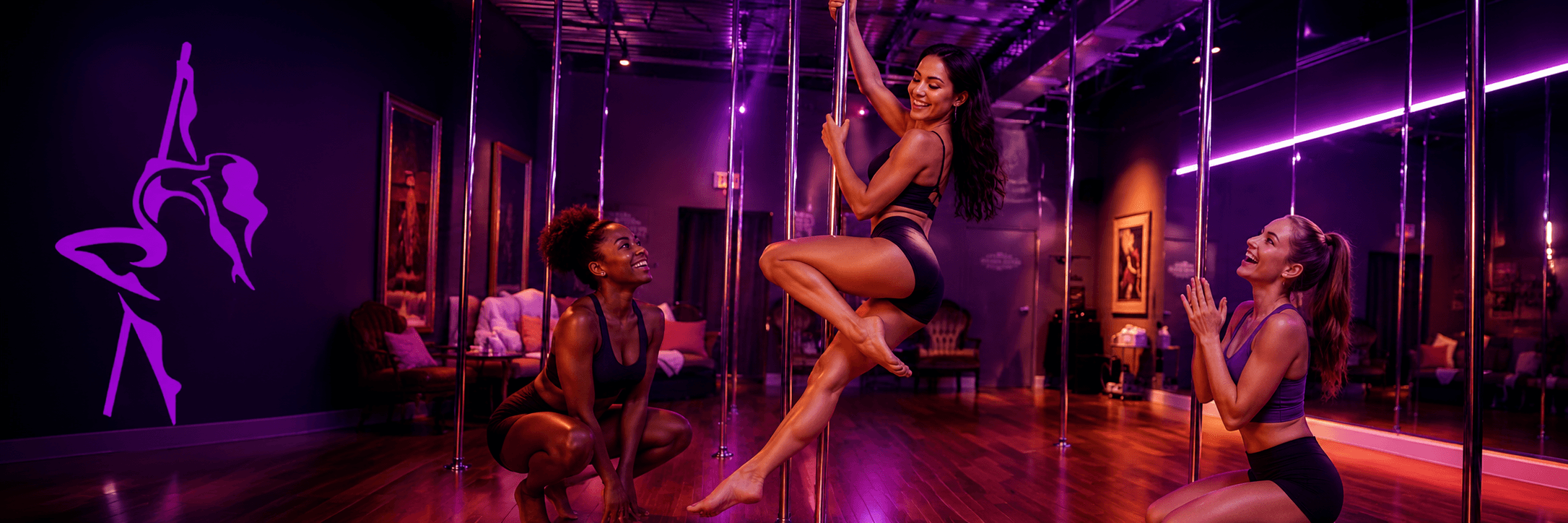
The gap between what women imagine and what actually happens in a Level 1 class is enormous. You arrive in form-fitting shorts and a sports top, bare feet, no jewelry, no lotion that day because lotion ruins your grip. You warm up as a group, learn to walk around the pole with intention, and practice one or two beginner spins with an instructor coaching your hand placement the whole time.
Intice sits at 2104 34th St S, in the same plaza as Domino's Pizza at the opposite end, with parking, lockers, changing rooms, a water station, and mats provided, so you can come straight from work with nothing but your shorts. Class levels run from Level 1 through Level 3+, and most students move from Level 1 to Level 1.5 after 8 to 10 classes. Students who attend two to three classes a week progress noticeably faster than once-a-week students, and most complete basic combinations within four to six weeks of regular attendance. Beyond pole, the studio also teaches twerk, heels, and chair dance if you want variety without losing the strength work, all listed on the services page.
COST AND COMMITMENT COMPARED
Barre memberships and pole memberships tend to land in similar territory, and drop-in pole classes around this area typically run somewhere in the range of $25 to $40, depending on the studio and format. Intice keeps the entry point deliberately low: new students get two weeks of unlimited classes for $59, which is enough time to take multiple Level 1 classes and feel the difference in your arms and back for yourself. Women who fall in love with it often move to the Ascend Unlimited membership at $375 per month for unlimited classes, though drop-ins are always welcome and no experience is ever needed.
The real cost question is not dollars. It is which one you will still be doing in six months. Barre attendance tends to fade when the routine feels repetitive. Pole keeps pulling you back because there is always a next spin, a next climb, a next level, and progress you can see.
KEY TAKEAWAY: Barre builds endurance in your legs, glutes, and core, but pole trains your entire body, including the pulling strength, grip, and upper body that barre never loads. If full body strength is the goal, pole is the more complete answer, and you do not need any existing strength to start.
If you are curious, the simplest next step is to try one beginner class and let your body cast the deciding vote. Check the current class times on the Intice schedule page and grab a spot in a Level 1 class this week.
FAQ
Q: Do I need upper body strength before starting pole, the way I would for pull-ups?
A: No. Level 1 classes are designed for women with no strength background at all, and the beginner spins use momentum and technique far more than raw muscle. The strength builds as a result of the classes, not as a prerequisite for them.
Q: Can I do barre and pole at the same time?
A: Absolutely, and they complement each other well. Barre's endurance and posture work supports your pole training, while pole fills in the pulling strength and upper body work barre leaves out.
Q: Where do women from around St. Pete actually train, and what should I bring to a first class?
A: Intice Dance Fitness is at 2104 34th St S in St. Petersburg, in the same plaza as Domino's Pizza, with parking, lockers, and changing rooms on site. Bring form-fitting shorts and a sports top, skip lotion and jewelry that day, and plan to go barefoot; mats, towels, and water are handled for you.
You Might Also Like