
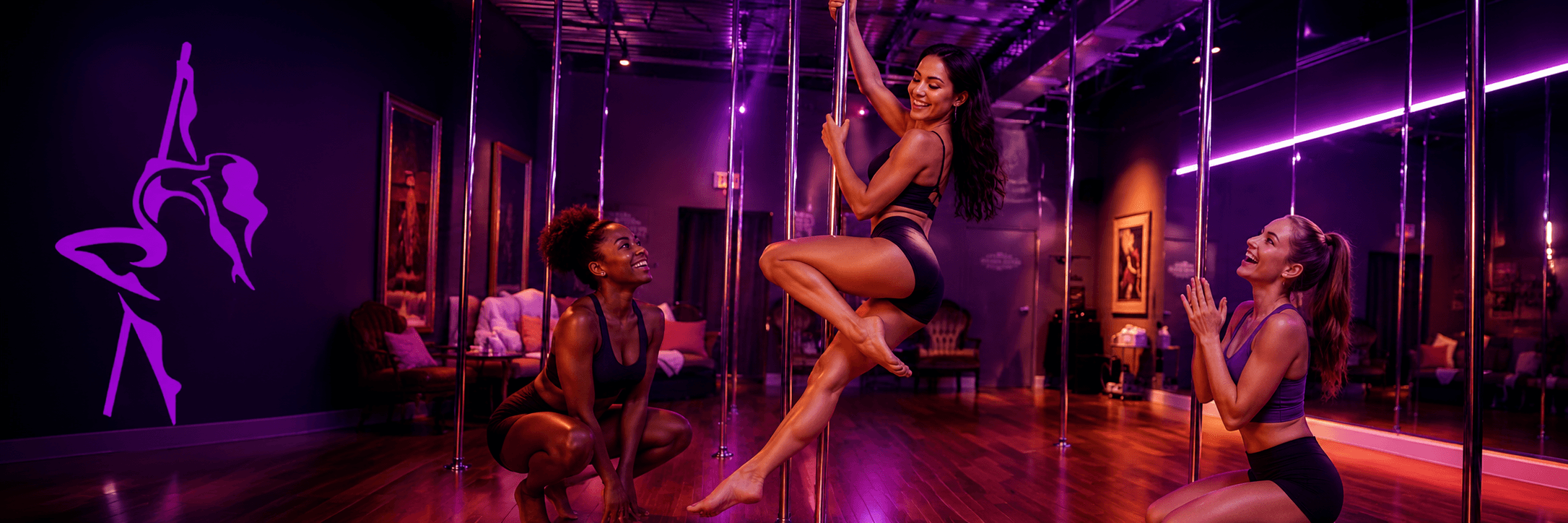
Is Pole Dancing Cardio or Strength Training? | St. Pete
Is pole dancing cardio or strength training? A St. Petersburg, FL instructor explains what a pole class really does for your body, even as a beginner.
Three questions come up almost every time a new student walks through our door. Does pole actually count as a real workout, or is it just dancing? Do I need to be strong before I start? And is pole dancing cardio or strength training, because I honestly don't know which one I need more. If you've been asking yourself any version of those questions here in St. Petersburg, FL this August 2026, this post is for you. Most of the women we teach arrive with no dance background, no gym habit, and a quiet suspicion that their body isn't the kind that does this. Let's answer all three questions honestly.
SO IS POLE DANCING CARDIO OR STRENGTH TRAINING
The short answer: it's both, and the balance shifts depending on the class and the level.
At Level 1, the strength side dominates. You spend the class gripping the pole, holding your body weight in small doses, learning to spin, and repeating movements that ask your arms, shoulders, back, and core to do things they haven't done in years, or maybe ever. Your heart rate climbs, but it climbs in waves. You work hard for thirty seconds, then rest while you watch a demonstration or wait your turn. That pattern looks a lot like interval training, and it feels a lot like strength work.
As you progress, the cardio side grows. Once you can string movements together, classes involve longer sequences with less rest. Combinations that link a spin into a floor transition into a climb keep you moving for minutes at a time, and by the end you're sweating the way you would in any conditioning class. Most of our students complete basic combinations within four to six weeks of regular attendance, and that's usually the point where they stop asking whether pole is a real workout, because their body has already answered.
So if you're choosing pole hoping to check the strength box, you will. If you're hoping to check the cardio box, you'll get there too. You just get them in a different order than you would at a gym.
WHERE THE STRENGTH COMES FROM WHEN YOU START WITH NONE
This is the part that stops most women from booking a first class: the belief that you need existing upper body strength to even begin. You don't. Level 1 is designed for bodies that have never trained, and the first classes rely far more on your legs, your grip, and momentum than on raw pulling power.
Strength builds because pole is bodyweight resistance training in disguise. Every spin asks your grip and forearms to hold on. Every floor transition asks your core to control the movement. Every attempt at a climb recruits your back and shoulders a little more than the last attempt did. You're not lifting a barbell, but you are lifting something heavier and more meaningful: yourself.
Most of our students are spinning on their own within their first one or two classes, and most move from Level 1 to Level 1.5 after eight to ten classes. That progression is your strength gains made visible. You can see the full range of what those levels include on our class offerings page, from pole fitness to twerk, heels, and chair dance, all of which build strength and conditioning in their own way.
WHERE THE CARDIO SNEAKS IN
Nobody walks out of a pole class saying it felt like a treadmill session, and that's exactly why it works. The cardio in pole is hidden inside movement you actually want to repeat. Learning a spin means doing it again and again. Drilling a floor sequence means staying low, moving continuously, and getting back up more times than you'd ever choose to do in a burpee workout.
Twerk and heels classes lean even more heavily toward the cardio end. They're dance-driven, they keep you on your feet for most of the class, and they leave your legs and lungs working. If you're curious about what pole demands of your body as a workout, we wrote a full breakdown in our post on whether pole dancing burns calories and what actually matters more.
The honest summary: pole won't replace marathon training if endurance running is your goal. But for a woman who wants her heart rate up without staring at a cardio machine's timer, it does the job while teaching her something.
HOW OFTEN SHOULD YOU COME TO FEEL BOTH
According to the CDC, adults need at least 150 minutes a week of moderate-intensity activity and at least 2 days a week of activities that strengthen muscles. A pole class covers both categories in one session, which is part of why it works so well for women who never managed to keep up a split routine of gym days and cardio days.
In our experience, students who attend two to three classes per week progress noticeably faster than those who come once a week. Twice a week is the sweet spot for most beginners: enough for your grip and shoulders to adapt, with recovery days in between while your body gets used to the work. Our intro offer, two weeks unlimited for $59 for new students, exists precisely so you can test that rhythm without committing to anything long term.
WHAT YOUR FIRST CLASS FEELS LIKE HERE IN ST PETE
Our studio sits at 2104 34th St S, in the same plaza as Domino's Pizza at the opposite end, with parking, changing rooms, lockers, a water station, and mats provided. Wear form-fitting shorts and a sports top, come barefoot, skip the jewelry, and don't put lotion on that day, since bare skin is what grips the pole.
Your first class will feel harder than you expect in some moments and easier in others. Your forearms will tire before anything else. You'll be sore in muscles you couldn't name. And you'll probably spin on your own before you leave, which is the moment most women decide they're coming back. Drop-ins are always welcome, and if you'd rather not commit to a membership yet, our class packs let you pay as you go.
KEY TAKEAWAY: Pole dancing is both cardio and strength training. It starts as strength-focused interval work for beginners and adds more sustained cardio as your skills grow, which means one class type covers what most women try to piece together from two or three different workouts.
If you've been going back and forth about trying it, stop debating and come feel the answer for yourself. Check the current class times on our schedule page and grab a spot in a Level 1 class this week.
FAQ
Q: Will pole dancing help me lose weight or just build muscle?
A: Pole combines resistance work and elevated heart rate, so it supports both goals, though results depend on consistency and what you do outside class. Most students notice strength changes first, in their grip and arms, with endurance and body composition changes following over weeks of regular attendance.
Q: I haven't worked out in years. Is Level 1 really beginner-friendly?
A: Yes, and you'll be in good company, because most of our students arrive with no dance or fitness background at all. Level 1 assumes zero existing strength, and instructors modify every movement so you work at your own starting point.
Q: Is there anywhere near St. Petersburg to try pole without a membership?
A: Intice welcomes drop-ins every day with no experience needed, and the studio is open Monday through Sunday from 6am to 10pm, so women across Pinellas County can find a class time that fits around work or kids. New students can also use the two weeks unlimited intro offer for $59 to try several class types before deciding.
You Might Also Like