
Is Pole Dancing Cardio or Strength Training? | St. Pete, FL
Is pole dancing cardio or strength training? An honest answer from a St. Petersburg, FL studio that teaches complete beginners every single week.
You're trying to figure out where pole would fit in your week, and two questions keep circling. Is pole dancing cardio or strength training? And if it's one or the other, does that mean you still need the gym on the side? Maybe a third question is hiding underneath those: does it even count as a real workout, or is it just dancing? Here in St. Petersburg, FL, in August 2026, we hear all three questions from new students almost every week — usually from women who haven't exercised regularly in years and want to know exactly what they're signing up for before they walk through the door. So let's answer them properly.
SO IS POLE DANCING CARDIO OR STRENGTH TRAINING
The honest answer: it's both, and the balance shifts depending on the class and the level.
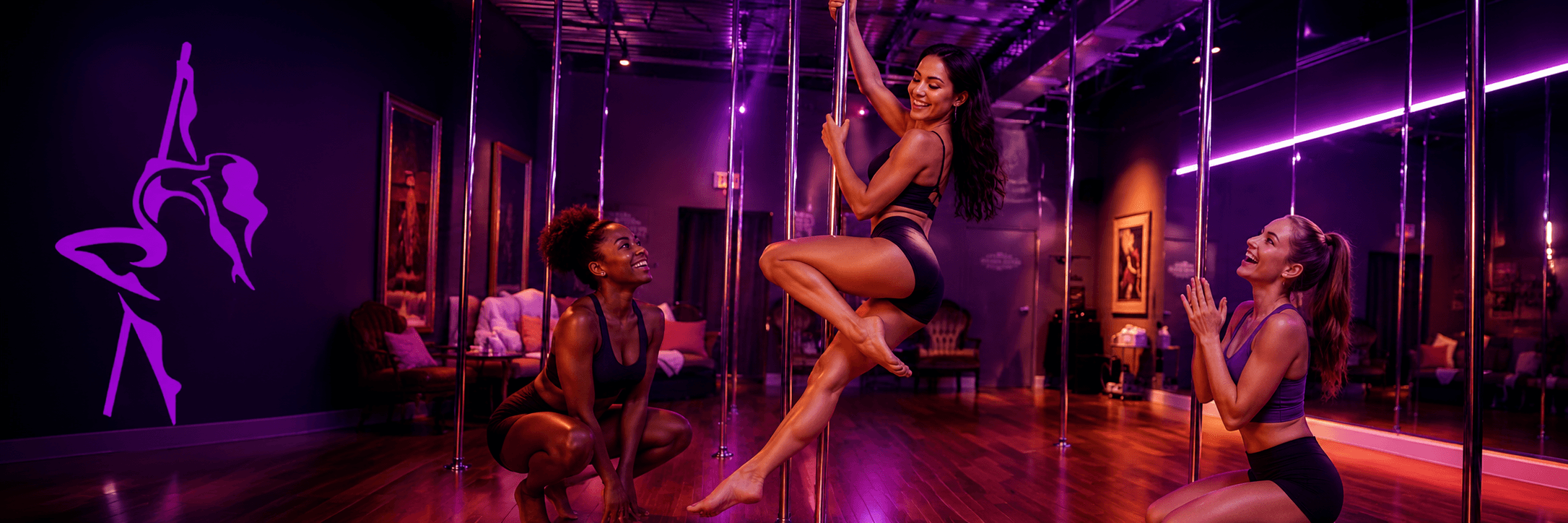
At its core, pole is strength training. Every time you grip the pole and spin, you're pulling your own bodyweight through space. Your hands, forearms, shoulders, back, and core are all working against resistance — the resistance just happens to be you instead of a dumbbell. This is why brand-new students often feel muscles the next day they didn't know they had, even after a class that felt more like play than exercise.
The cardio arrives through the format. A beginner pole class isn't one lift followed by three minutes of rest. It's warm-up, drills, spins repeated on both sides, floorwork, and short choreography sequences that keep you moving for most of the hour. Your heart rate climbs and stays elevated in waves, closer to interval training than to a steady jog.
That combination matters more than most people realize. According to the CDC, adults need at least 150 minutes a week of moderate-intensity activity and at least 2 days a week of activities that strengthen muscles. Most workouts check one box. Pole is one of the few that genuinely works toward both in a single session.
WHAT THE STRENGTH SIDE ACTUALLY FEELS LIKE
Nobody hands you a barbell, and nobody counts reps at you. The strength work is built into the movement itself.
In your first few classes, the biggest demand is on your grip and your pulling muscles. Holding the pole, walking around it with intention, and executing your first spins asks your hands and back to do work they probably haven't done since childhood monkey bars. Then your core joins in. Controlling a spin — rather than just flinging yourself around the pole — requires your midsection to stay engaged the entire time.
As you progress from Level 1 toward Level 1.5 and beyond, the strength demands grow with you. Climbs, holds, and inverts are essentially bodyweight resistance exercises with better music. Most students at Intice move from Level 1 to Level 1.5 after 8 to 10 classes, and by that point they can usually feel the difference in everyday life: grocery bags feel lighter, stairs feel easier, and pushing open a heavy door stops being a two-hand job.
WHERE THE CARDIO KICKS IN
The cardio side of pole is sneaky, and that's its best quality.
A choreography section might only be sixty seconds of movement, but you'll run it five, six, seven times as you learn it. Spins get drilled on your left side and your right. Floorwork transitions have you moving up and down from the ground repeatedly. By the end of class you're flushed, breathing hard, and reaching for your water — the fans and water station at the studio exist for a reason.
The interesting part is that you rarely notice it happening. When you're focused on nailing a spin or hitting a move on the beat, you're not staring at a treadmill timer. The hour goes fast. For women who describe themselves as "cardio haters," this tends to be the first format where the cardio doesn't feel like punishment. If you're curious how that stacks up against a traditional workout, we've written honestly about pole dancing and calorie burn — including which common claims to ignore.
WHAT IF I HAVE NEITHER STRENGTH NOR STAMINA RIGHT NOW
This is the question underneath the question, and it deserves a straight answer: you do not need to arrive with either.
Most women who start at Intice come in with no dance background and no fitness routine at all. Level 1 is built for exactly that starting point. Spins are taught with both feet near the floor first. Instructors break every movement into small pieces, and you're never asked to hold your full bodyweight before your grip is ready for it. Most students are spinning on their own within their first one or two classes — not because they arrived strong, but because beginner spins are designed to build the strength as you go.
The strength and the stamina are outcomes of the class, not prerequisites for it. Attending two to three classes a week produces noticeably faster progress than once a week, but even one consistent class builds a base over time. You can browse the full range of formats — pole, twerk, heels, chair dance and more — on the services page to see what fits your comfort level first.
WHY THIS MATTERS IF YOU LIVE IN ST. PETERSBURG
Practically speaking, a workout that covers both cardio and strength in one hour solves a real scheduling problem. If your current plan requires a gym membership for weights plus separate cardio sessions, and you keep skipping one or the other, one combined class you actually look forward to will beat two you avoid.
Intice sits at 2104 34th St S — same plaza as Domino's Pizza, opposite end — with parking, lockers, changing rooms, and mats provided, so you can come straight from work with just shorts and a sports top. The studio is open 6am to 10pm daily; check the schedule for exact class times. Drop-ins are always welcome, and new students can try 2 weeks unlimited for $59, which is enough time to feel both the strength and the cardio effects for yourself.
KEY TAKEAWAY: Pole dancing is genuinely both cardio and strength training — bodyweight resistance work wrapped inside continuous, interval-style movement — and you don't need to arrive with either kind of fitness to start, because Level 1 builds both from zero.
Ready to feel the difference in your first hour instead of reading about it? Check the schedule and book a beginner class — bare feet, no jewelry, no lotion, and no experience required.
FAQ
Q: Will one pole class a week be enough to see fitness results?
A: One class a week builds skills and a strength base, but progress comes slower. Students who attend 2 to 3 classes weekly progress noticeably faster, and most complete basic combinations within 4 to 6 weeks of regular attendance.
Q: Do I still need a gym membership if I do pole?
A: Many students find pole covers most of what they were getting from the gym, since it combines pulling strength, core work, and elevated heart rate in one session. Some keep lifting on the side for lower-body volume, but plenty make pole their only workout and stay consistent for the first time in years.
Q: Is pole a serious enough workout in the Florida heat, or will I overheat?
A: Local women worry about this, especially in summer, but the studio has fans, a water station, and towels, and classes build intensity gradually rather than pushing you into the red. Wear form-fitting shorts and a sports top, hydrate before you arrive, and skip lotion on class day so your grip stays reliable in the humidity.
You Might Also Like