
Is Pole Dancing Cardio or Strength Training? | St. Pete, FL
Is pole dancing cardio or strength training? A St. Petersburg, FL instructor explains what a pole class actually does for your body.
Three questions come up constantly from women thinking about their first class. Is pole dancing cardio or strength training? Do I have to pick one or the other? And if I'm already tired of the treadmill and bored of dumbbells, is pole actually going to count as a real workout, or is it just dancing around a pole? It's August 2026, it's brutally hot outside, and if you're a woman in St. Petersburg, FL wondering whether pole can replace the gym routine you keep abandoning, these are fair questions. Here are honest answers from someone who has taught hundreds of first-timers.
SO IS POLE DANCING CARDIO OR STRENGTH TRAINING
Both, and the balance shifts depending on what you're doing in class.
The strength side is obvious the moment you grip the pole. Holding your own body weight, even for a few seconds, is resistance training. Your grip, forearms, shoulders, back, and core are all working against gravity. In a Level 1 class, you're not doing anything acrobatic, but you are repeatedly pulling, holding, and controlling your body around a vertical bar. That's strength work whether it feels like a workout or not. And it usually does feel like one by the next morning.
The cardio side sneaks up on you. A pole class isn't one long static hold. You're moving through walks, spins, floorwork, and transitions, often back to back, and your heart rate climbs and stays elevated for stretches of the class. Choreography-based classes and combination work push the cardio element harder. Conditioning drills and skill work lean more toward strength. Most classes blend the two, which is exactly why so many students stop needing separate gym sessions to feel worked.
The CDC recommends that adults need at least 150 minutes a week of moderate-intensity activity and at least 2 days a week of activities that strengthen muscles. A regular pole practice can contribute meaningfully to both categories at once, which is rare for a single activity. Running covers one. Lifting covers the other. Pole overlaps them.
WHY IT DOESN'T FEEL LIKE EITHER ONE
This is the part women don't expect. Pole is strength training that doesn't feel like counting reps, and cardio that doesn't feel like staring at a timer.
When you're learning a spin, your brain is occupied with technique, timing, and where your hands go. You're not watching the clock. You're not thinking about how many sets are left. The effort is real, but the experience is play. Students routinely finish class shaking and sweaty, genuinely surprised, because it didn't register as exercise while it was happening.
That matters more than it sounds. The workout you keep showing up for beats the technically perfect one you quit in March. If you've cycled through gym memberships and running apps and never stuck with any of them, the problem probably wasn't discipline. It was boredom. If you're weighing pole against a traditional gym setup, this comparison of pole versus the gym goes deeper on exactly that trade-off.
BUT I HAVE NO STRENGTH TO START WITH
Almost nobody does. This is the single most common worry we hear, and it has the whole thing backwards.
You don't build strength first and then start pole. You start pole, and the strength builds because of it. Level 1 classes assume zero fitness background. You'll learn grip, basic walks, and simple spins that use momentum and technique far more than muscle. Most of our students are spinning on their own within their first one or two classes, not because they're secretly strong, but because beginner moves are designed for beginner bodies.
The strength arrives quietly. After a few weeks, jars open easier. Grocery bags feel lighter. Somewhere around eight to ten classes, most students move from Level 1 to Level 1.5, and by then the pull-and-hold work that felt impossible on day one feels routine. Most students complete basic combinations within four to six weeks of regular attendance. None of them started strong. They got strong by showing up.
HOW OFTEN DO I NEED TO COME FOR IT TO COUNT
If pole is going to be your main workout, aim for two to three classes a week. Students who train at that frequency progress noticeably faster than once-a-week students, and it also lines up neatly with the recommendation of at least two muscle-strengthening days per week.
You don't need to abandon everything else. Plenty of students pair pole with walking, swimming, or a yoga class. But if pole is the only structured exercise you do, two to three sessions weekly gives you a legitimate blend of resistance work and elevated-heart-rate movement, plus flexibility and mobility work woven into warm-ups and cool-downs.
WHAT TRAINING BOTH SIDES LOOKS LIKE IN ST. PETERSBURG, FL
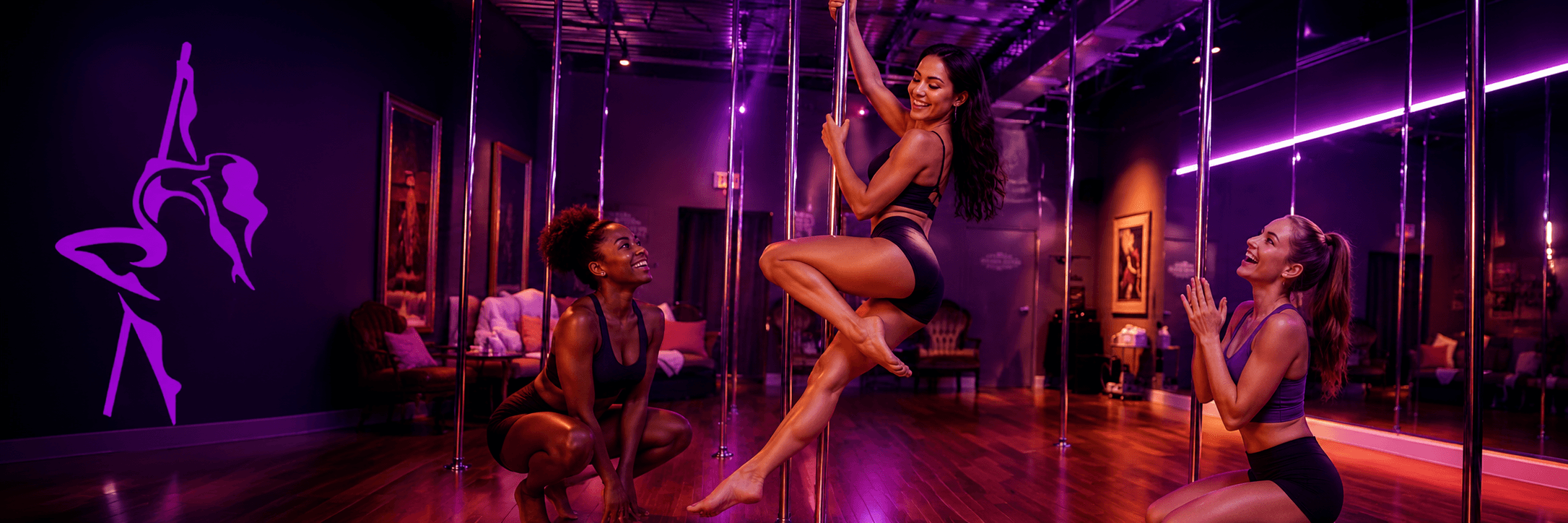
At Intice, the class lineup is built so you can hit both ends of the spectrum without ever touching a barbell. Pole fitness and pole dance classes handle the strength-plus-cardio blend. Twerk, heels, and chair dance classes lean harder into cardio, coordination, and endurance. You can see the full range of class types on our services page.
The studio sits at 2104 34th St S, in the same plaza as Domino's Pizza at the opposite end, with parking, lockers, changing rooms, a water station, and fans, which matter in a Florida August. Doors are open Monday through Sunday, 6am to 10pm, so early risers and after-work students can both find times that fit. Levels run from Level 1 through Level 3+, and drop-ins are always welcome with no experience needed.
New students get 2 weeks unlimited for $59, which is genuinely the best way to answer this question for yourself. Take a pole class, a twerk class, and a heels class in the same two weeks and feel where the strength work ends and the cardio begins. If you fall for it, the Ascend Unlimited membership runs $375 per month for unlimited classes.
KEY TAKEAWAY: Pole dancing is both cardio and strength training in one activity. Skill work and holds build real muscular strength, choreography and transitions keep your heart rate up, and training two to three times a week can cover both sides of a balanced fitness routine.
Ready to find out what your body can actually do? Check the class schedule and grab a spot in a Level 1 class this week.
FAQ
Q: Will pole dancing help me lose weight?
A: Pole combines resistance work with elevated-heart-rate movement, so it can absolutely be part of a routine that supports weight loss. Results depend on your consistency, nutrition, and starting point, so we never promise a specific outcome. What we can say is that students who attend regularly get measurably stronger and build endurance.
Q: Is a pole class harder than a gym workout?
A: It's different rather than harder. A gym isolates muscles with fixed loads, while pole asks your whole body to work together against your own weight, which recruits stabilizing muscles most gym routines miss. Beginners are often sore in places they didn't know existed, but every Level 1 class is scaled for women with no fitness background.
Q: What do local women usually wear to class in the Florida heat?
A: Form-fitting shorts and a sports top, bare feet, no jewelry, and skip the lotion on class day, since skin contact is how you grip the pole. Our studio has fans, a water station, and towels, so even in the thick of a Tampa Bay summer you'll be comfortable. Changing rooms and lockers make it easy to come straight from work.
You Might Also Like