
How to Start Pole Dancing With No Upper Body Strength | St. Pete
How to start pole dancing with no upper body strength — why waiting to get strong first backfires, and what actually works in St. Petersburg, FL.
You cannot do a pull-up. You may not be able to do a single push-up on your toes. And every time you think about trying a pole class, a voice says: get in shape first, then go. If that voice has kept you on the couch through another Tampa Bay summer, this August 2026 is a good time to look honestly at the two paths in front of you — because one of them quietly works, and the other one keeps women waiting for years.
There are really two approaches to starting pole when your arms feel like they have nothing to give. Let's compare them properly.
THE TWO WAYS WOMEN THINK ABOUT STARTING POLE
Path one: prepare first. Spend a few months at the gym building upper body strength, then show up to a pole class feeling ready.
Path two: start now. Walk into a Level 1 class exactly as you are and let the pole itself become your strength training.
Both sound reasonable. Only one of them tends to actually get women on the pole. Here is why.
OPTION ONE WAIT UNTIL YOU FEEL STRONG ENOUGH
The prepare-first plan has genuine logic behind it. General strength work is valuable, and if you already love lifting, nothing about pole asks you to stop. Rows, dead hangs, and core work all carry over beautifully.
The problem is not the training. The problem is the finish line, because there isn't one. "Strong enough" is not a number anyone can give you. Women who take this path rarely reach a day where they think, now I qualify. The gym becomes a waiting room, and the waiting room becomes the whole plan.
There is a second problem: gym strength and pole strength are not the same skill. Pole relies heavily on grip endurance, skin contact, body positioning, and knowing where your weight actually is in space. A woman who can press respectable dumbbells overhead can still find her first spin humbling, and a woman who has never touched a weight can find it surprisingly doable — because Level 1 is built for her, not for the lifter.
And strength training in general is exactly where women tend to fall short. According to the CDC's National Center for Health Statistics, in 2020, 28.3% of men and 20.4% of women met the guidelines for both aerobic and muscle-strengthening activities. If the traditional gym were working for most women, that gap would not exist. Telling yourself to fix your strength at the gym before you're allowed to do the thing you actually want to do is, for many women, a plan with a built-in failure point.
OPTION TWO HOW TO START POLE DANCING WITH NO UPPER BODY STRENGTH
The start-now path flips the order. Instead of building strength so you can pole, you pole so you build strength.
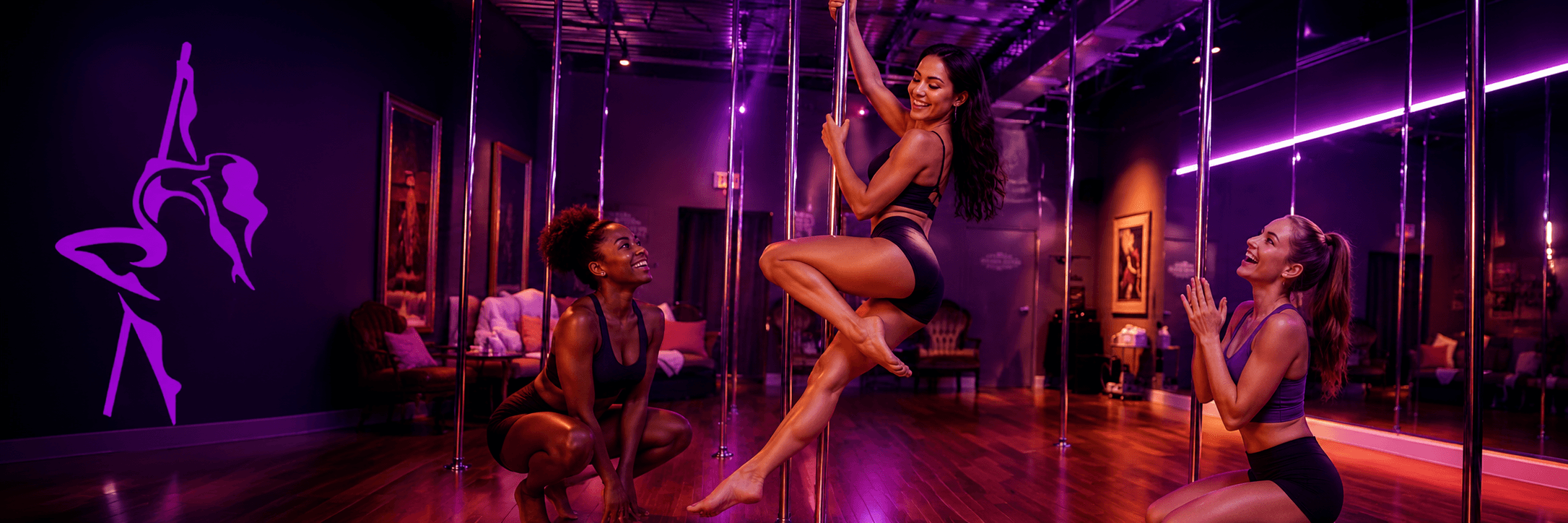
Here is how that works in practice at Intice. A Level 1 class does not open with climbs or inverts. It opens with walks around the pole, weight shifts, pivots, and low spins where your feet stay near the floor and your body weight is shared between your legs, your hips, and your hands. Your grip is challenged in small doses. Your shoulders learn to engage before they are ever asked to hold you. Nothing in your first class assumes you can support your full body weight with your arms, because almost nobody walking in can.
The progression takes care of itself. Most Intice students are spinning on their own within their first one to two classes. Most move from Level 1 to Level 1.5 after 8 to 10 classes, and most are putting together basic combinations within 4 to 6 weeks of regular attendance. Students who come 2 to 3 times a week progress noticeably faster than once-a-week students — not because they arrived stronger, but because grip and shoulder strength respond quickly to frequent, low-dose practice. That is strength training. It just doesn't look like a barbell.
If you want a preview of what that first hour feels like minute by minute, read what to expect at your first pole dancing class before you book. Knowing the shape of the class removes most of the fear.
WHAT YOUR FIRST FEW CLASSES ACTUALLY ASK OF YOUR ARMS
Concretely: holding the pole at chest or head height while your feet carry most of your weight. Short spins lasting a few seconds. Gripping, releasing, resting, repeating. Your forearms will feel it first — that pleasant, worked ache the day after — long before your biceps or shoulders are ever tested.
Instructors modify constantly. If a spin feels like too much load, you'll get a floor-supported version. Mats are provided, and the studio has stretch bands, foam rollers, and a water station, so warm-up and recovery are handled for you. Wear form-fitting shorts and a sports top, come barefoot, skip the jewelry, and don't put lotion on that day — bare skin is how you grip, which matters far more than muscle in week one.
Pole is one class type on the menu, not the whole menu. Twerk, heels, and chair dance classes build coordination, rhythm, and lower-body strength with almost no upper body demand at all, and plenty of women use them as a confidence bridge into pole. You can see the full range on the services page.
WHY SO MANY TAMPA BAY WOMEN START EXACTLY WHERE YOU ARE
The women in a Level 1 class are not athletes. They are teachers, nurses, moms, and desk workers who have not done a pull-up since middle school, if ever. The studio at 2104 34th St S — in the same plaza as Domino's Pizza, at the opposite end — sees new students walk in every week convinced they are the weakest person who has ever tried this. They are wrong, and by week three they are usually the ones reassuring the next nervous newcomer.
The intro offer makes the start-now path cheap to test: two weeks of unlimited classes for $59, new students only. Two weeks is enough time to feel your grip change, which is usually all the proof anyone needs.
KEY TAKEAWAY: You do not build strength in order to start pole — you start pole in order to build strength. Level 1 classes assume no upper body strength at all, and the progression from walks to spins to combinations creates the strength as you go.
Ready to stop waiting for a version of yourself that the pole will build for you anyway? Check the class schedule and grab a spot in a Level 1 class this week.
FAQ
Q: Will I embarrass myself if I can't hold my own body weight?
A: No, because nothing in Level 1 requires you to hold your full body weight with your arms. Your feet stay on or near the floor for most of your first classes, and instructors offer modified versions of every move so you're never stuck watching.
Q: How long before I actually feel stronger?
A: Grip and forearm strength typically change first, often within the first couple of weeks of consistent classes. Most students who attend two to three times a week are completing basic combinations within four to six weeks, which requires strength they did not have on day one.
Q: I'm not in St. Petersburg proper — is the drive worth it for a beginner?
A: Women drive in from across Pinellas County and beyond because true beginner-level instruction is worth the trip. The studio is easy to reach off 34th Street South, parking is available, and with hours from 6am to 10pm daily there is likely a class time that fits around your commute — check the schedule page for exact times.
You Might Also Like