
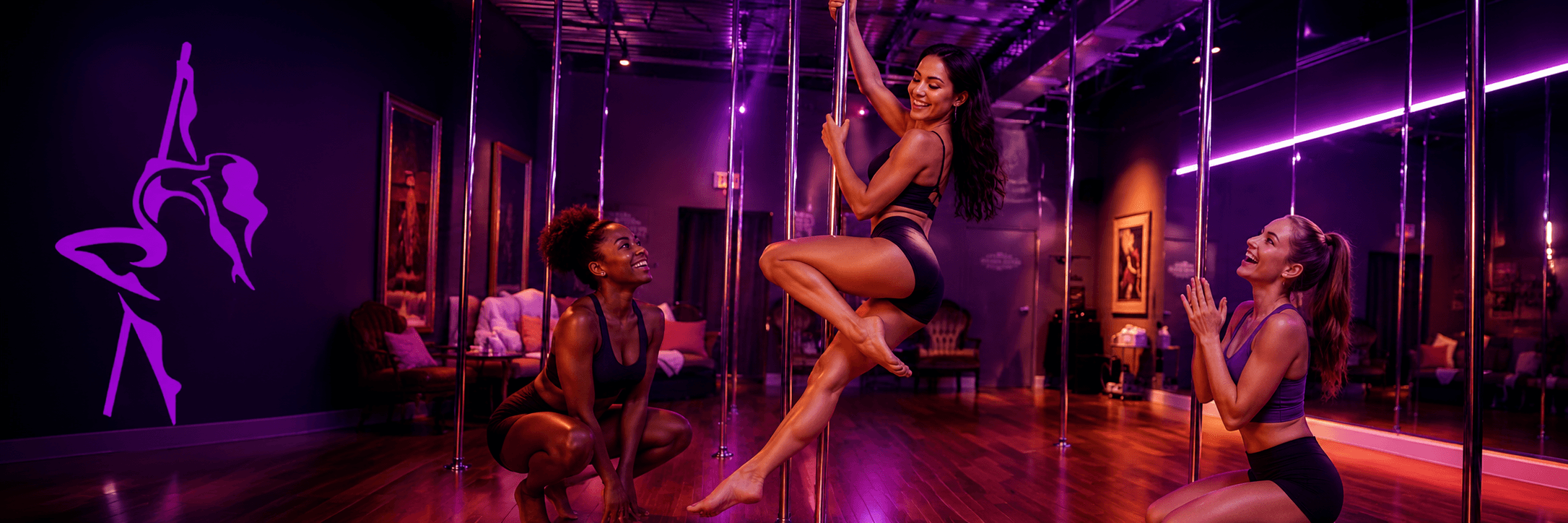
Pole Dancing vs Barre for Full Body Strength | St. Pete
Pole dancing vs barre for full body strength: an honest comparison for Tampa Bay women deciding which workout actually builds real strength.
You want to get stronger, but the gym bores you, and you keep circling the same two options: the barre studio with the pretty grey walls, or the pole studio you have driven past a dozen times and never walked into. It is August 2026, you are somewhere in Tampa Bay scrolling class schedules at night, and the real question underneath the search is simple. Which one will actually make my whole body stronger, and which one am I actually capable of doing? Let's compare them honestly, because both deserve a fair look.
WHAT BARRE ACTUALLY TRAINS
Barre earns its reputation. It borrows from ballet, pilates, and physical therapy, and it is built around small, controlled movements done at high repetition with light resistance or just your own body weight. Think tiny pulses in a low squat until your thighs shake, isometric holds that light up muscles you forgot you had, and lots of attention to posture and alignment.
Barre is genuinely good at muscular endurance, especially in the legs, glutes, and core. It is low impact, gentle on joints, and welcoming if you have never exercised. Many women who feel intimidated by weights find barre a kind first step, and it teaches body awareness that carries into everything else you do.
Where barre has limits is load. Those tiny pulses fatigue a muscle, but they rarely ask it to move something heavy. Your upper body in particular gets a light touch in most barre formats. Light hand weights and planks are common, but pulling strength, grip strength, and the ability to support your full body weight are almost never trained. Endurance improves. Raw, functional strength grows more slowly.
WHAT POLE ASKS OF YOUR BODY
Pole works from the opposite direction. From your first spin, you are gripping, pulling, and eventually holding your own body weight against a vertical apparatus. That is resistance training, and the resistance is you.
The muscles involved are hard to fake: forearms and grip, biceps, shoulders, lats, upper back, and a core that has to brace constantly to keep you controlled instead of swinging. Your legs work too, squeezing the pole in climbs and holds, and your glutes fire in ways floor work rarely demands. It is a pulling-dominant, full-body workout, which matters because pulling is exactly what most women's training is missing. Barre, pilates, running, and most group fitness are push-and-hold formats. Almost nothing in a typical woman's routine trains her to pull her own weight.
That gap shows up in the national numbers. According to the CDC's National Center for Health Statistics, in 2020, 28.3% of men and 20.4% of women met the guidelines for both aerobic and muscle-strengthening activities. Women under-train strength as a group, and workouts that feel like dance while quietly loading the muscles are one of the most sustainable ways to close that gap.
If you are worried you need strength before you start, you have it backwards. You build the strength by starting. Nobody at Intice arrives able to climb. Most students are spinning on their own within their first one to two classes, using momentum and technique long before muscle takes over. The strength comes as a byproduct of showing up.
POLE DANCING VS BARRE FOR FULL BODY STRENGTH WHICH BUILDS MORE
Put them side by side and the picture is clear but nuanced.
For lower body endurance and postural control, barre is excellent and arguably faster to feel. Your legs will burn in your first class and your posture cues will be constant.
For total-body strength, especially the upper body, pole has the edge, and it is not close. Barre asks your arms to hold a one-pound weight for many reps. Pole eventually asks your arms to hold you. That difference in load is the difference between toning and building. Progressive overload happens naturally in pole because every new spin, climb, and hold demands slightly more than the last one, the same principle that makes strength training work anywhere. If you want the longer version of that argument, the comparison in our pole versus pilates breakdown applies almost word for word to barre.
For core strength, call it closer than you would expect. Barre trains the core deliberately with mat work. Pole trains it constantly and incidentally, because staying controlled on a spinning apparatus is a core exercise disguised as choreography.
Honest verdict: if your goal is gentle conditioning and you love the ballet aesthetic, barre is a legitimate choice and you should not let anyone talk you out of it. If your goal is genuinely full body strength, including the pulling strength barre cannot load, pole builds more, and it keeps building for years because the skill ladder never runs out.
WHAT A BEGINNER ACTUALLY FEELS IN HER FIRST MONTH
Week one, your forearms are tired and your grip surprises you. That is normal and temporary. By weeks four to six of regular attendance, most students at Intice are completing basic combinations, and the women coming two to three times a week progress noticeably faster than those coming once. Most students move from Level 1 to Level 1.5 after eight to ten classes. None of that requires prior fitness, and levels at the studio run from Level 1 through Level 3+, so there is a clear next step for years.
Classes here go beyond pole too, including twerk, heels, and chair dance, so your strength work never has to feel like a chore. You can see everything offered on the services page.
TRYING POLE IN TAMPA BAY WITHOUT ANY EXPERIENCE
Intice Dance Fitness sits at 2104 34th St S in St. Petersburg, in the same plaza as Domino's Pizza at the opposite end, with parking, lockers, changing rooms, a water station, and mats provided. The studio is open Monday through Sunday, 6am to 10pm, with class times listed on the schedule page. Wear form-fitting shorts and a sports top, come with bare feet, skip the jewelry, and do not put lotion on that morning. Drop-ins are always welcome, and new students can try two weeks of unlimited classes for $59, which is enough time to feel the strength difference for yourself rather than taking anyone's word for it.
KEY TAKEAWAY: Barre builds endurance and postural control beautifully, but pole loads your full body weight, which is what actually builds strength, especially the upper-body pulling strength most women's workouts never touch.
If you are ready to find out what your body can actually do, we would love to teach your first class. Pick a beginner-friendly time on our schedule and just show up curious.
FAQ
Q: Do I need any barre, dance, or fitness background before my first pole class?
A: No. Most women who walk into Intice have no dance or fitness background at all, and Level 1 classes assume exactly that. Instructors break every spin into small steps and most students are spinning on their own within their first one to two classes.
Q: Can I do both barre and pole at the same time?
A: Yes, and they pair well. Barre supports the flexibility, alignment, and lower-body endurance that make pole movement cleaner, while pole adds the pulling strength and grip work barre does not load. Just leave a rest day between hard sessions while your body adapts.
Q: Is there a way for local women to try pole without committing to a membership?
A: Yes. Women across St. Petersburg and the surrounding Pinellas County area can drop in to any class with no experience needed, and new students get two weeks of unlimited classes for $59. That is plenty of time to compare how pole feels against whatever you are doing now before deciding on anything ongoing.
You Might Also Like