
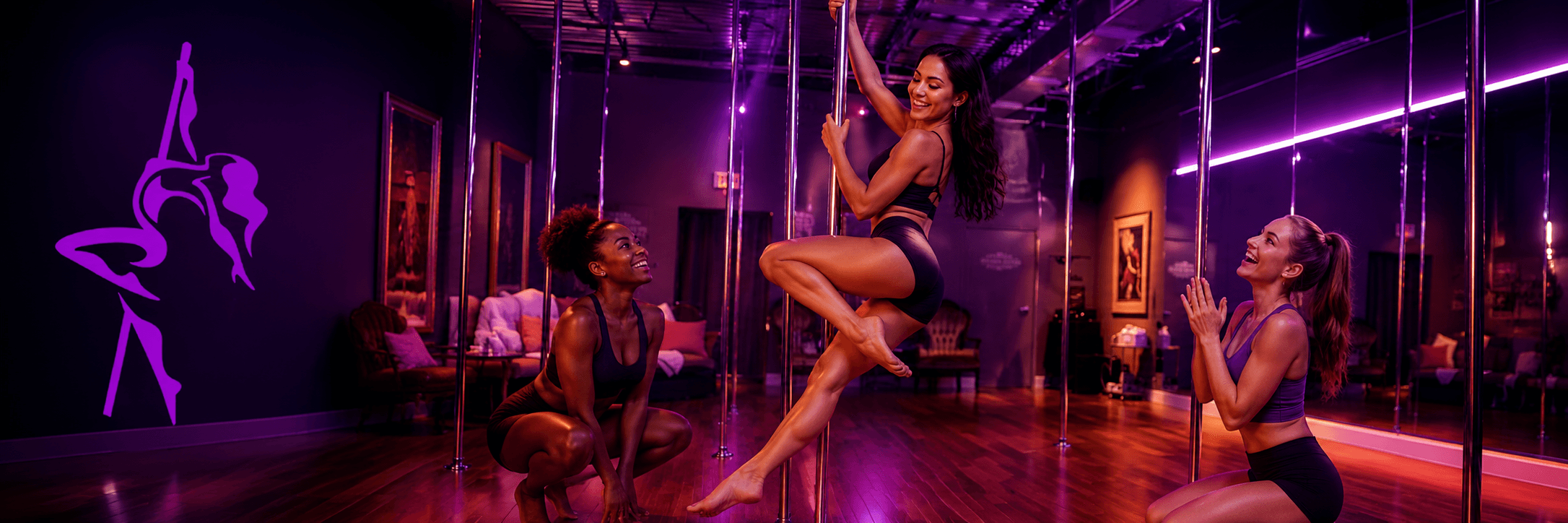
What Is a Shoulder Mount in Pole Dancing? Myths Corrected
What is a shoulder mount in pole dancing? An instructor explains the move, the myths around it, and why it is learned in class.
A shoulder mount is an advanced pole inversion in which the dancer stands with her back to the pole, rests it against one shoulder, holds on above that shoulder, and lifts her legs up and over her head until she is upside down. If you typed "what is a shoulder mount in pole dancing" into a search bar in November 2026 after seeing a clip on social media, you probably picked up a few myths along the way. The common ones are that it is purely an arm move, that you can copy it from a video, and that a sore shoulder means you did it wrong. I hear all of these regularly as an instructor, and each one deserves a correction.
WHAT IS A SHOULDER MOUNT IN POLE DANCING
In most inverts, the dancer faces the pole or stands beside it. The shoulder mount is different because the pole is behind her. It sits against the muscle at the top of one shoulder, beside the neck, and her hands hold the pole above that shoulder.
From there, her legs leave the floor and travel up and overhead, so she tips backward into an inverted position. The legs may be tucked, opened into a wide straddle, or held straight together, depending on the variation and the dancer's strength.
Done well, it looks like the dancer is floating backward around a single fixed point. That floating quality is why the move gets so much attention online. It is also why it gets underestimated.
WHAT LEVEL IS IT AND WHAT COMES BEFORE IT
The shoulder mount is generally considered an advanced move. It is not a first-class skill, and it is not a first-inversion skill either.
Before working toward it, a dancer typically has:
- Confident, controlled climbs.
- A solid basic invert she can do without jumping or kicking.
- Real comfort being upside down.
- The core strength to lift her hips with control.
- Reliable grip, and the body awareness to know where she is in space when she cannot see the pole.
Studios place this move differently in their own progressions. At Intice Dance Fitness in St. Petersburg, classes run from Level 1 through Level 3+, and the best way to find out where the shoulder mount falls is to ask your instructor. She can also tell you what she would want to see from you first.
WHAT DOES A SHOULDER MOUNT BUILD
The move and the conditioning that leads up to it train the whole body.
The deep core and hip flexors do the lifting. The back muscles, especially the large ones along the sides of the torso, pull and stabilize. The shoulders learn to stay active and engaged under load, and the hands and forearms work hard throughout.
It also builds coordination. Tipping backward toward a pole you cannot see takes spatial awareness and trust in your own preparation. Dancers often describe their first clean shoulder mount as a milestone because it reflects so much earlier work.
If you want to know how pole develops that foundation, our post on upper body and grip strength in pole is a good place to start.
WHAT DO PEOPLE GET WRONG ABOUT THE SHOULDER MOUNT
Myth: it is all arm strength.
The arms hold the dancer in place, but the lift comes mostly from the core and back. Dancers with strong arms can still struggle with this move, while dancers who have patiently built core control often progress more smoothly. This is why instructors spend so much time on conditioning before the move itself.
Myth: you can learn it from a video.
This is the misconception that worries me most. The pole sits close to the neck, and the placement details that matter are nearly invisible on camera. A video cannot see you, correct you, or catch you. The shoulder mount must be learned in person with a qualified instructor, with spotting and crash mats. It should never be attempted alone or at home.
Myth: if it hurts, you are doing it wrong.
Pressure where the pole meets the shoulder is common while learning. So are tender skin and light bruising, which pole dancers call "pole kisses." These usually ease as the body adapts. Sharp pain is different, and so is any pain in the neck. Stop immediately and tell your instructor.
Myth: you are not a real pole dancer until you can do one.
Plenty of skilled dancers build rich, beautiful practices without ever making this move a priority. It is one option among many, not an entry requirement.
HOW IS IT LEARNED SAFELY IN A CLASS
In a studio, the shoulder mount is approached in stages. An instructor will usually begin with conditioning work that builds the needed strength well before a student tries the full move. She then decides, student by student, when the next stage is appropriate.
When that time comes, she spots you hands-on, with crash mats in place. She also chooses the grip and leg variation that suits your body. There are several, and picking between them is a judgment call that belongs to someone who can watch you move.
Some students like focused, one-on-one time for a move like this. In that case, private lessons let an instructor concentrate entirely on your progression.
Check with a doctor before starting pole if you have an injury or medical condition, particularly one involving the neck, shoulders, or back. Skin contact creates grip, so wear form-fitting shorts and a sports top, and skip the lotion on class day.
No one can promise when, or whether, a particular move will come. What I can say is that every dancer you have seen do a shoulder mount started with the basics.
KEY TAKEAWAY: The shoulder mount is an advanced backward inversion that depends on core strength, back strength, and precise placement near the neck. It is learned safely in class with a qualified instructor, spotting, and crash mats, and never alone or at home.
If the shoulder mount caught your eye, come start building toward it with an instructor who can guide you through each stage. Drop-ins are always welcome and no experience is needed, so take a look at our class schedule and pick a time that works for you.
FAQ
Q: Can I try a shoulder mount at home if I have a pole?
A: No. This is an advanced inversion with the pole positioned close to the neck, and it should be learned in class first with a qualified instructor, spotting, and crash mats. Practicing it alone, even on a well-installed home pole, removes every safeguard that matters.
Q: I am a complete beginner. Is a shoulder mount something I could work toward?
A: Many dancers who do this move started with no experience, but no one can honestly promise that you will get it or how long it might take. At Intice Dance Fitness in St. Petersburg, new students can begin with 2 weeks of unlimited classes for $59. Your instructor can explain where the shoulder mount sits in the Level 1 through Level 3+ progression.
Q: Does a shoulder mount hurt?
A: Pressure on the shoulder, skin tenderness, and light bruising are common while learning, and they usually settle as your body adapts. Sharp pain or any pain in the neck is a signal to stop right away and speak with your instructor. If you have an existing injury or medical condition, check with a doctor before you start.
You Might Also Like