
How to Stop Comparing Your Body to Other Women at the Gym | St. Petersburg, FL
Learn how to stop comparing your body to other women at the gym and why pole classes in St. Petersburg make it easier to focus on you.
You walk in, you clock the woman on the treadmill with the flat stomach, the one in the squat rack with the arms, the one by the mirror who seems to live there, and before you have touched a single weight you have already decided you are the worst body in the room. If you have been trying to figure out how to stop comparing yourself to other women at the gym, you are not vain and you are not weak. You are doing what nearly every woman does the moment she steps onto a gym floor, and most of us were never taught another way. At Intice, our pole studio in St. Pete, this is one of the most common things new students whisper to us in October 2026, and it was just as common ten years ago. So let's take apart the three beliefs that keep the comparison running, and then talk about what actually helps.
IS EVERYONE AT THE GYM REALLY LOOKING AT ME
The first belief is that other women are watching you, measuring you, and quietly ranking you. It feels completely real. You can almost sense the eyes.
Here is what instructors see from the front of a room, class after class: everyone is doing the exact same thing you are. The woman you think is judging your thighs is wondering if her shirt rode up. The one with the "perfect" arms is annoyed that her left side is weaker than her right. People at the gym are overwhelmingly focused on themselves, their reps, their phone, their own reflection.
The feeling of being watched usually comes from inside. You are watching yourself through an imagined stranger's eyes, and that stranger is harsher than any real person in the building. Naming that is the first step, because you cannot stop a habit you believe is a fact.
DO I NEED TO LOOK A CERTAIN WAY BEFORE I BELONG IN A CLASS
The second belief is that fitness spaces are for women who are already fit, and you need to earn your way in by losing weight or toning up first. This one keeps women on the couch for years.
Think about what that logic means. You would wait until you are strong to start building strength. You would wait until you are comfortable in your body to start doing the thing that typically builds comfort in your body. It is backwards, and most women know it is backwards, yet it still feels true at the door.
A pole studio turns this belief inside out, because almost nobody arrives looking like a pole dancer. Most of the women who come through our door have no dance or fitness background at all. They are stiff from desk jobs, out of practice, or have never been athletic a day in their lives. Level 1 is built for exactly that starting point, and the women around you are at that starting point too. Belonging is not something you earn with a before-and-after. You belong the moment you show up in a pair of shorts.
WILL THE COMPARING STOP ONCE I GET FITTER
The third belief is the sneakiest: once I lose the weight or get the muscle, I will finally stop comparing. Many women have chased that finish line and discovered it moves. A smaller body just gets measured against an even smaller one. New definition in your arms gets measured against someone else's shoulders.
Comparison is a habit of attention, not a reflection of your body. It only loosens when you give your attention somewhere else, and a physical goal that has nothing to do with appearance is one of the most reliable places to send it. This is part of why pole can be so useful for women stuck in this loop. The question in class is never "how do I look," it is "can I hold this spin," "can I get my hip to the pole," "can I climb one hand higher than last week." Those questions have answers you can feel, and they belong only to you.
HOW TO STOP COMPARING YOUR BODY TO OTHER WOMEN AT THE GYM
Here are the practical habits we see work for students, over and over.
Pick a skill, not a shape. Walk in with a task. At Intice it might be a fireman spin, a basic climb, or simply keeping your grip through a full count. When your brain has a job, it has less room to scan the room.
Look at what bodies do, not what they look like. Train yourself to notice the woman who finally nailed her invert, the one who is shaking but still holding, the one who laughed when she fell out of a spin and got right back up. You will start to admire effort instead of sizing up outlines, and that shift tends to spread to how you see yourself.
Keep a progress record that is not a photo. Write down what you did in each class. Two spins instead of one. Held the pole sit a breath longer. At our studio, most students are spinning on their own within their first one or two classes and completing basic combinations within four to six weeks of regular attendance. Those are things a scale and a mirror cannot show you.
Interrupt the thought out loud. When "she looks so much better than me" shows up, answer it with a sentence about what you are doing: "I am here to work on my climb." It feels silly and it works.
Choose a room that has your back. Some gym floors are built for anonymity. A small class with an instructor who knows your name is harder to disappear in, and harder to spiral in. If you want a preview of what that looks like, our post on what to expect at your first pole dancing class walks through the first hour minute by minute. There is also some early evidence that pole specifically shifts how women feel about their bodies. In a small pilot trial of 50 women published by Pfeiffer et al., 2023, BMC Psychology, an eight-week pole dance program improved mental wellbeing, body appreciation, sexual self-esteem and sexual self-efficacy, and reduced sexual anxiety compared with a waitlist group. It is one small study, not a guarantee, but it matches what we watch happen on the floor.
WHY POLE CLASSES IN ST. PETERSBURG FEEL DIFFERENT FROM THE GYM FLOOR
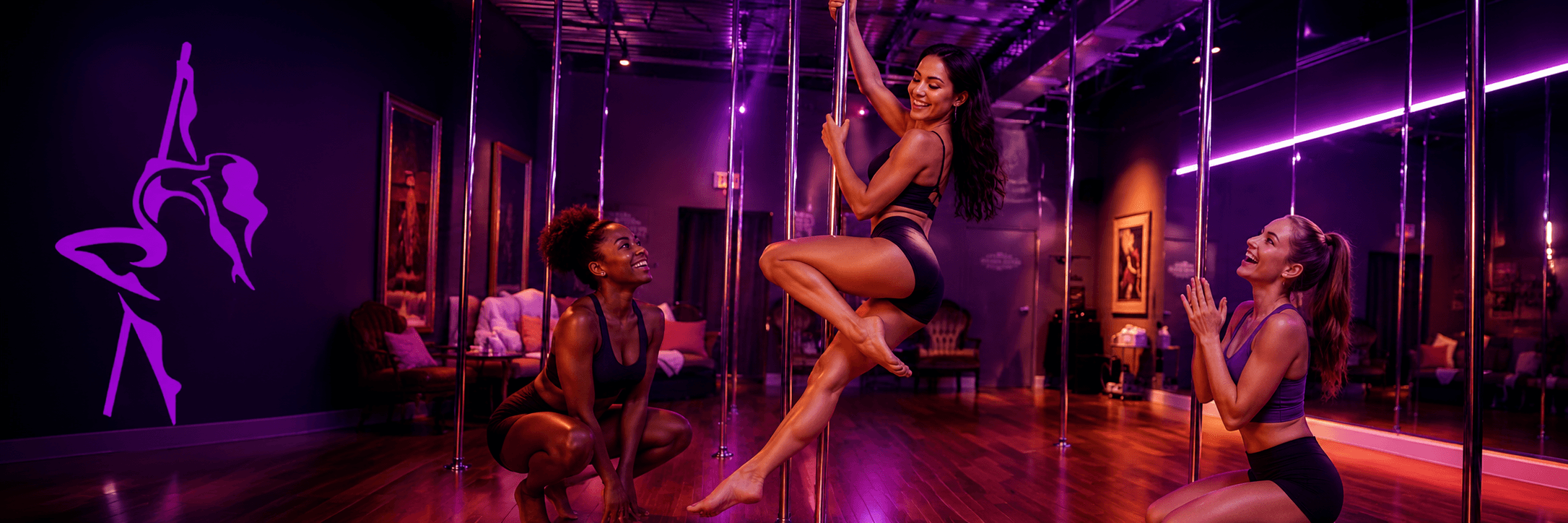
Our studio sits on 34th St S in the same plaza as Domino's, at the opposite end, and the room is nothing like a big-box gym. There are no rows of machines facing a wall of mirrors you cannot escape. There is a pole, an instructor, and a handful of women who are also learning. Fans keep the room comfortable, mats are provided, and there is a waiting lounge where new students tend to sit nervously before their first class and chat easily after it.
The culture matters most. Because everyone starts with bare feet, no lotion, form-fitting shorts and a sports top, nobody is hiding in baggy layers and nobody is pretending. Bruises on the inner thigh are a shared badge rather than something to cover. When a classmate lands a move, the room cheers, and that cheering gets extended to you when it is your turn. It is hard to keep ranking yourself against women who are actively rooting for you.
New students can try two weeks of unlimited classes for $59, which is enough time to notice the difference between watching other bodies and finally paying attention to your own. If you still have questions about levels, what to wear, or whether you need any strength to start, our FAQs page covers the most common ones.
KEY TAKEAWAY: Comparison is a habit of attention, not a verdict on your body, and the fastest way to break it is to give your attention a physical skill that belongs only to you, in a room where the women around you are cheering rather than ranking.
Come see what it feels like to work on a move instead of a mirror. Check the schedule and book your first class whenever it fits your week.
FAQ
Q: What if I am the biggest or least fit woman in the class?
A: In a Level 1 class at Intice, almost everyone is starting from scratch, and body size has very little to do with who picks up a spin first. Instructors offer modifications for every move, and your only job is to work on your own next step, not to keep pace with anyone else.
Q: Do women in St. Petersburg pole classes really not judge each other?
A: Every class has a mix of ages, sizes, and starting points, and the shared experience of learning something hard tends to build quick camaraderie. Local students often tell us the room feels safer than their gym because everyone is visibly struggling and visibly improving together.
Q: Will I still compare myself to others once I am in a pole class?
A: Probably at first, because the habit does not switch off overnight. What changes is that you have a concrete skill to redirect your attention to, and over several weeks most students find they are too busy chasing their own progress to keep score on anyone else.
You Might Also Like