
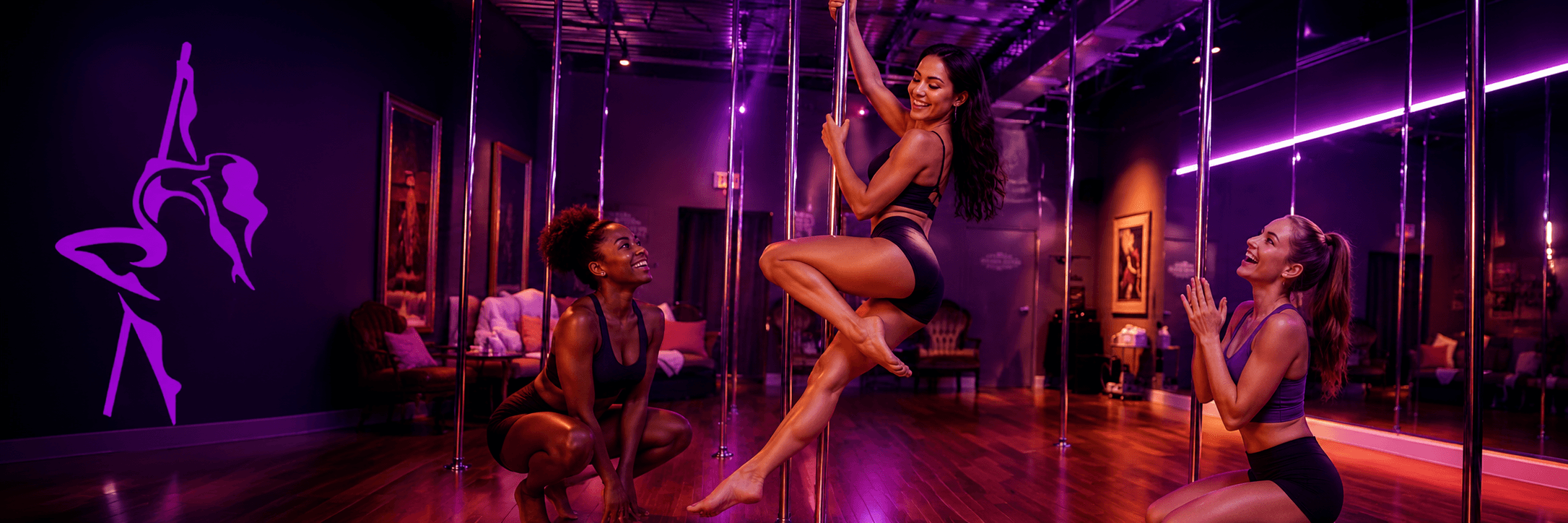
How Does Pole Dancing Change Your Body | St. Petersburg, FL
How does pole dancing change your body? What women in St. Petersburg, FL really notice in strength, posture, and grip after a few weeks on the pole.
You have probably asked yourself some version of these three questions. Will pole actually make me stronger, or is it just dancing around a pole? Will my body look different, or only feel different? And do I need to already be fit before I walk in the door? If it is August 2026 and you are in St. Petersburg, FL wondering how pole dancing changes your body when you are starting from nothing, those are exactly the right questions to ask. This post answers all three honestly, without promising you a specific dress size or a timeline that ignores how bodies actually work.
Let's take them one at a time.
SO HOW DOES POLE DANCING CHANGE YOUR BODY
The short answer: pole is resistance training disguised as dance. Every spin, climb, and hold asks your muscles to move and control your own bodyweight, which is the same principle behind pull-ups, planks, and weighted rows. The difference is that you are learning choreography while you do it, so the effort hides inside the fun.
The muscles that respond first are the ones many women rarely train on purpose: forearms and grip, shoulders, upper back, and the deep core muscles that stabilize your spine. That matters more than most people realize. According to the CDC's National Center for Health Statistics, in 2020, 28.3% of men and 20.4% of women met the guidelines for both aerobic and muscle-strengthening activities. Women, as a group, under-train strength — and pole fills that gap almost by accident, because you cannot spin without gripping and you cannot climb without pulling.
You do not need any of that strength on day one. You build it by showing up. At Intice, most students are spinning on their own within their first one to two classes, using momentum and technique long before raw strength arrives.
WHERE YOU FEEL IT FIRST
Before anything changes in the mirror, things change in your hands. Grip strength comes fast, and you notice it in small ways — jars open easier, grocery bags feel lighter, your forearms feel awake in a way they have not since childhood monkey bars.
Next comes your upper back and shoulders. Holding your body against the pole recruits muscles between your shoulder blades that desks and phones have quietly switched off. Many students describe standing taller within a few weeks, not because anyone corrected their posture but because the muscles that hold good posture finally have a job again.
Your core follows. Pole core work is not crunches. It is bracing, twisting, and controlling your legs in the air, which trains the deep stabilizers rather than just the surface muscles. Expect soreness in places you did not know had names. That soreness is normal, it fades, and the studio keeps foam rollers, stretch bands, and mats on hand so you can recover properly after class.
WHAT CHANGES YOU CAN SEE AND WHAT YOU CAN ONLY FEEL
Visible changes vary from woman to woman, and anyone who promises you a specific result by a specific date is selling something. What typically shows up with consistent training is muscle definition in the shoulders, arms, and back, along with the kind of leg and glute development that comes from climbs, floor work, and holds. Some women notice their clothes fitting differently. Others notice almost nothing in the mirror for a while and then catch their reflection mid-spin and realize their whole silhouette has changed. We wrote more about realistic expectations in our post on pole dancing before and after results, because the honest version is more interesting than the airbrushed one.
Frequency matters more than intensity. Students who attend two to three classes per week progress noticeably faster than those who come once a week, and most students complete basic combinations within four to six weeks of regular attendance. Your body changes on the same schedule your skills do — steadily, in response to consistent practice, not overnight.
THE CHANGES NOBODY PHOTOGRAPHS
Some of the biggest shifts never show up in a before-and-after photo. Coordination improves, because pole demands that your arms, legs, and core cooperate in ways treadmills never ask of you. Flexibility improves gradually, especially in the hips and shoulders, because every class includes intentional warm-up and stretch time.
Then there is the change most students mention first when you ask them: how they carry themselves. Learning to hold your own bodyweight does something to the way you walk into rooms. That is not a mystical claim — it is what happens when a woman who believed she was weak finds out, spin by spin, that she is not. Body awareness improves too. You start knowing where your hips are in space, how your weight shifts, what your shoulders are doing. That awareness follows you out of the studio and into everything else.
WHAT TRAINING LOOKS LIKE AT OUR ST. PETERSBURG, FL STUDIO
Intice sits at 2104 34th St S, in the same plaza as Domino's Pizza at the opposite end, and the studio is open seven days a week from 6am to 10pm. Classes run from Level 1 through Level 3+, and most students move from Level 1 to Level 1.5 after eight to ten classes. Beyond pole, the studio teaches twerk, heels, and chair dance, so your training can stay varied — you can see the full lineup on our services page.
Everything you need is provided: lockers, mats, towels, a water station, changing rooms, fans, and parking. Wear form-fitting shorts and a sports top, come barefoot, skip the jewelry, and do not apply lotion on class day — bare skin is how you grip the pole. New students can try two weeks of unlimited classes for $59, which is enough time to feel the first changes for yourself rather than taking anyone's word for it.
KEY TAKEAWAY: Pole dancing changes your body by training grip, upper back, shoulders, and core through bodyweight resistance — strength most women never build elsewhere — and the changes arrive through consistency, typically two to three classes a week, not overnight.
Your body will not change by reading about pole, but it will start changing the week you try it. Grab a spot in a Level 1 class on our schedule page and come see what your first spin feels like.
FAQ
Q: How long before I notice my body changing from pole?
A: Most students feel changes — better grip, less desk stiffness, easier posture — within the first few weeks, well before anything is visible. Visible muscle definition typically follows with consistent attendance over a couple of months, and two to three classes per week speeds everything up.
Q: Will pole dancing make me bulky?
A: Bodyweight training like pole builds lean, functional strength rather than bulk. Most women develop defined shoulders, arms, and back muscles along with improved posture, which reads as athletic rather than big.
Q: Do women in St. Petersburg really do this with no fitness background?
A: Constantly. Most of the women who walk into Intice have no dance or fitness background at all, and drop-ins are always welcome with no experience needed. Level 1 classes are built for complete beginners, and instructors modify everything to where your body is right now.
You Might Also Like