
Pole Dancing for Women Who Were Never Athletic | St. Pete
Pole dancing for women who were never athletic is more common than you think. How non-sporty beginners in St. Pete build strength from absolute zero.
You were picked last for teams. You faked a stomachache during the mile run. You have spent your adult life quietly filing yourself under "not a gym person," and every workout you have ever tried seemed to assume you already knew what you were doing. If that is you, this post is for you — because women with no athletic history at all walk into our Tampa Bay studio every single week, and in October 2026 they make up a huge portion of our beginner classes. Pole was not built for former gymnasts. It works best for women starting from nothing, and the difference between the gym path and the pole path explains why.
WHY FEELING UNATHLETIC IS NOT THE PROBLEM YOU THINK IT IS
Most women who call themselves unathletic are not describing their bodies. They are describing their history. Nobody taught them how to move, nobody made movement feel good, and somewhere along the way they decided the problem was them.
You are also in enormous company. According to the CDC's National Center for Health Statistics, among all adults aged 18 and over, 24.2% met the guidelines for both aerobic and muscle-strengthening activities, 22.7% met only the guidelines for aerobic activity, 6.8% met only the guidelines for muscle-strengthening activity, and 46.3% did not meet the guidelines for either type of activity. Nearly half of adults are not regularly active at all. The woman walking into her first pole class with zero background is the norm, not the exception.
The real question is not whether you are athletic. It is whether the activity in front of you was designed to teach you or designed to test you. That is where the comparison matters.
THE GYM PATH VS THE POLE PATH WHEN YOU ARE STARTING FROM ZERO
Think about what a traditional gym asks of a beginner. You walk in, and the equipment is just there. You are expected to know how to use it, how much weight to pick, how many reps to do, and how to structure a session. Gyms do this well for people who already have a plan — the access, the variety, and the flexibility are genuinely valuable for self-directed exercisers. But for a woman with no fitness background, the gym hands her a blank page and wishes her luck. Most of us fill that blank page with twenty awkward minutes on a treadmill and never come back.
Now compare the pole path. A pole class is taught, start to finish. An instructor tells you exactly where to put your hands, which foot steps first, and what the next ten minutes hold. There is no programming to figure out, no machine to decode, no decision fatigue. You follow along, and the skill builds itself one piece at a time. At Intice, every class type we offer — pole fitness, pole dance, twerk, heels, chair dance — is structured this way, with levels running from Level 1 through Level 3+ so you are never dropped into material you have not been prepared for.
The gym path rewards women who already know how to train. The pole path teaches women who never learned. That is the entire difference, and it is why a non-athletic background matters far less here than it does almost anywhere else.
POLE DANCING FOR WOMEN WHO WERE NEVER ATHLETIC
So what does pole dancing for women who were never athletic actually look like in practice? Slower and more encouraging than you are picturing.
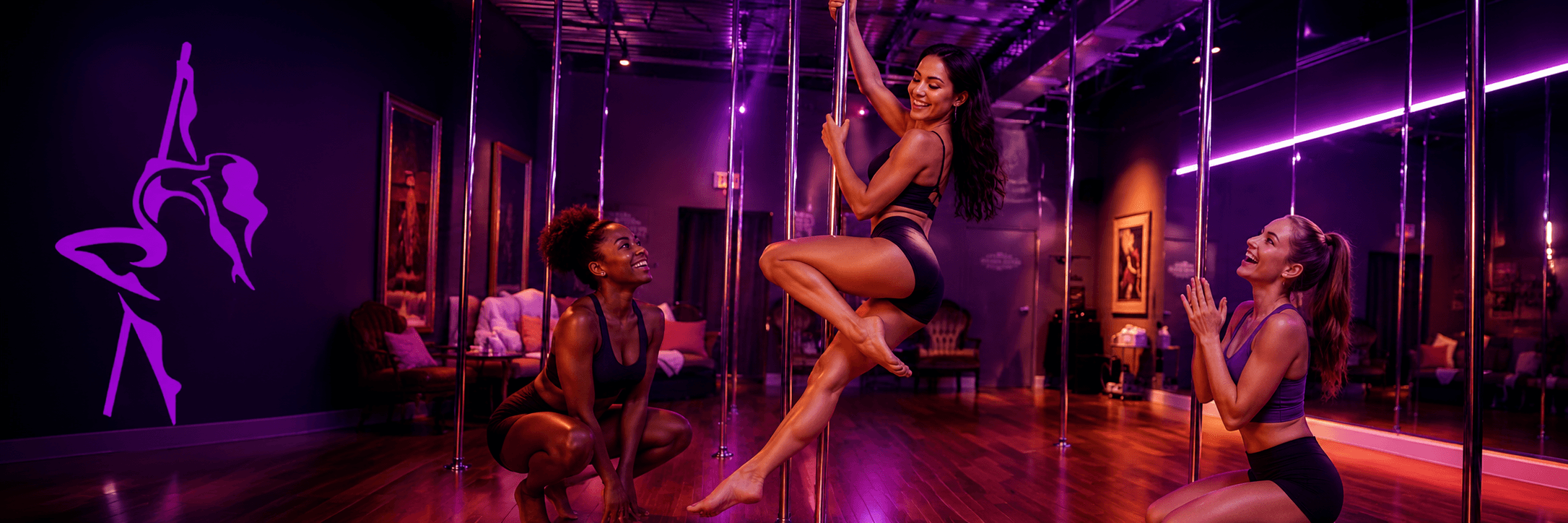
Your first classes are mostly walking around the pole, learning basic grips, and trying simple spins close to the floor. Most students are spinning on their own within their first one to two classes — not because they arrived strong, but because beginner spins use momentum and technique, not muscle. The strength you think you need to start is actually something you build by starting. Your grip, shoulders, and core get worked a little more each class, and the pole quietly becomes your strength training without a single dumbbell involved.
Progress is gradual and visible. Most students complete basic combinations within four to six weeks of regular attendance, and most move from Level 1 to Level 1.5 after eight to ten classes. Students who come two to three times a week progress noticeably faster than those who come once a week — but once a week still moves you forward, which is more than most abandoned gym memberships can say. If you are wondering how steep the learning curve really is, we broke it down honestly in is pole dancing hard to learn for beginners.
WHAT IF EVERYONE ELSE IN CLASS IS ALREADY GOOD
This is the fear underneath the fear, so let's address it directly. Level 1 classes are full of women exactly like you — nurses, teachers, moms, office workers — most of whom arrived with no dance or fitness background whatsoever. Nobody in a beginner class is performing. Everyone is concentrating too hard on their own hands and feet to evaluate yours.
There is also no scoreboard in pole. Nobody keeps your time, counts your reps against the woman next to you, or posts results. When someone in class lands her first spin, the room cheers, because every woman in there remembers wobbling through her own. Women who hated the competitive edge of sports often find this is the first physical environment that ever felt safe.
WHAT STARTING LOOKS LIKE AT OUR ST PETE STUDIO
You will find us at 2104 34th St S, in the same plaza as Domino's Pizza at the opposite end, with free parking right outside. The studio is open Monday through Sunday, 6am to 10pm, and drop-ins are always welcome with no experience needed. Lockers, changing rooms, a water station, mats, and a waiting lounge are all here, so you only need to bring yourself.
Wear form-fitting shorts and a sports top, come barefoot, skip the jewelry, and skip lotion on class day — skin grip is how beginners hold the pole safely. New students get two weeks of unlimited classes for $59, which is enough time to try several class types and feel your body start to change before committing to anything long term.
KEY TAKEAWAY: Being "not athletic" describes your history, not your ability. Pole classes are taught step by step from absolute zero, which is why women with no sports or fitness background routinely become the students who stick with it longest.
Your first spin is closer than you think, and you do not have to be anything other than curious to earn it. Browse the class schedule and pick a Level 1 class that fits your week.
FAQ
Q: I have truly never exercised as an adult. Is Level 1 still too advanced for me?
A: No — Level 1 assumes nothing. You will learn how to grip the pole, how to walk around it, and basic spins that rely on momentum rather than strength. The class is built for women on day one, and instructors offer modifications whenever something feels out of reach.
Q: Do most beginners at Intice come from a fitness background?
A: Most do not. The majority of women training with us across St. Pete and Pinellas County arrive with no dance or fitness history at all, which shapes how every beginner class is taught. You will be surrounded by women who started exactly where you are.
Q: How long before I feel less clumsy on the pole?
A: Most students are spinning on their own within their first one to two classes, and basic combinations typically come together within four to six weeks of regular attendance. Coordination is a learned skill, not a trait you were born without, and consistent weekly classes build it faster than you would expect.
You Might Also Like