
Pole Dancing vs CrossFit for Building Real Strength: Which One Wins?
Pole dancing vs CrossFit for building real strength — we compare both so you can find the workout that actually transforms your body.
If you've been weighing pole dancing vs CrossFit for building real strength this July 2026, you're asking exactly the right question. Both workouts have passionate communities, both promise serious results, and both will absolutely challenge you. But they build strength in very different ways — and depending on your goals, your body, and honestly, how much fun you want to have while getting strong, one of them might be a far better fit. As a studio full of women who came to pole from gyms, boot camps, and yes, CrossFit boxes, we've seen this comparison play out in real life hundreds of times. Here's the honest breakdown.
HOW CROSSFIT BUILDS STRENGTH
Let's give credit where it's due: CrossFit works. It's built around functional movements — squats, deadlifts, presses, pull-ups, kettlebell swings — performed at high intensity, often against the clock. The programming is designed to build raw power, explosive speed, and cardiovascular endurance all at once.
The strength you build in CrossFit is largely external-load strength. You get stronger by progressively lifting heavier weights. That's effective, and for people who love barbells and competition-style training, it's incredibly motivating.
But CrossFit has trade-offs. The high-intensity, high-volume style carries a real injury risk, especially for beginners performing complex lifts under fatigue. The environment can feel intimidating if you're not already athletic. And for many women, the "beat the clock" culture starts to feel like a grind rather than something to look forward to. Strength training only works if you keep showing up — and that's exactly where pole quietly pulls ahead.
HOW POLE DANCING BUILDS STRENGTH
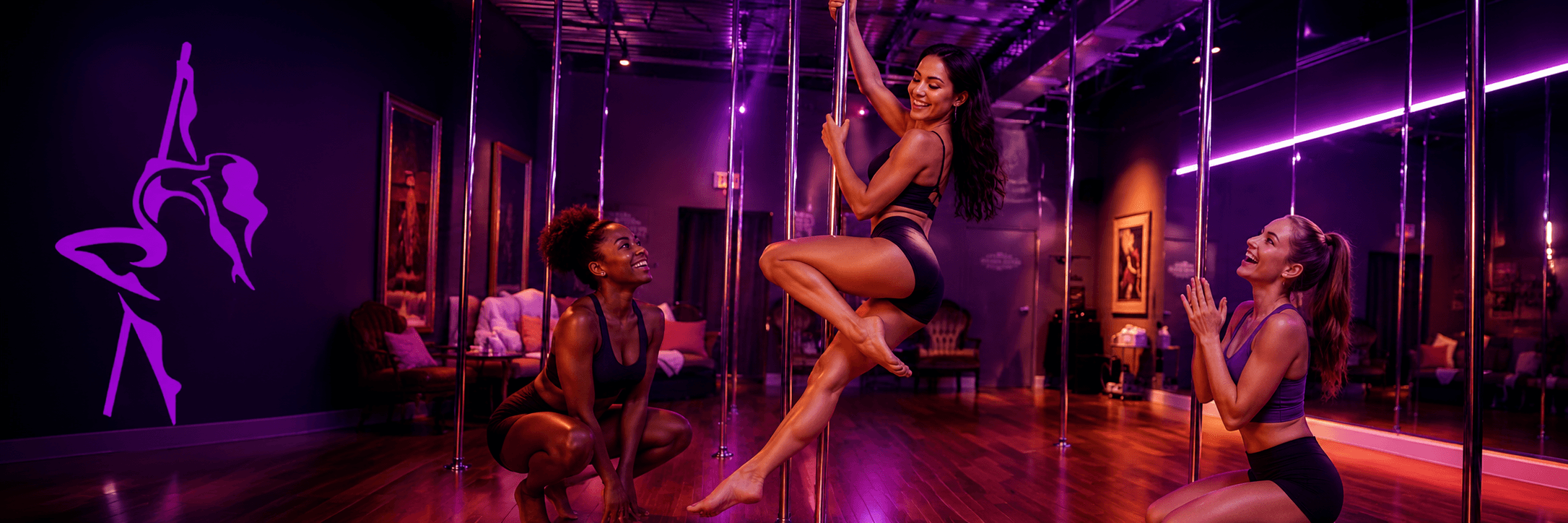
Pole dancing is bodyweight strength training in disguise. Every spin, climb, and hold requires you to lift, control, and stabilize your entire body against gravity. There's no barbell — you ARE the weight.
Think about what a basic pole climb demands: grip strength, pulling power through your back and biceps, core engagement to keep your body controlled, and leg strength to secure your position. That's essentially a weighted pull-up, a hanging leg raise, and an isometric hold happening simultaneously. Intermediate moves like inversions and leg hangs take it even further, building the kind of relative strength — strength in proportion to your own bodyweight — that most gym-goers chase for years.
According to the American Council on Exercise, bodyweight training ranks among the most effective methods for building functional strength precisely because it trains multiple muscle groups and stabilizers together rather than isolating them. That's pole in a nutshell. Students at our studio routinely discover they can do pull-ups they never trained for, simply because pole demanded that strength move by move.
The other secret weapon? Progression feels like play. In CrossFit, progress means adding plates. In pole, progress means unlocking a new trick — your first climb, first spin combo, first inversion. That built-in reward system keeps people consistent, and consistency is the single biggest driver of strength gains. If you're curious what those gains actually look like, check out our post on pole dancing before and after fitness results — the transformations speak for themselves.
HEAD TO HEAD: STRENGTH, INJURY RISK, AND STICKING WITH IT
Upper body and grip strength: Pole wins decisively. Very few workouts on earth build pulling strength, grip endurance, and shoulder stability like pole does. CrossFit trains pulling too, but pole makes it the centerpiece of nearly every movement.
Core strength: Pole, again. Every hold and transition is a core exercise. CrossFit trains the core, but often as a supporting player rather than the star.
Lower body power: CrossFit takes this one. Heavy squats and deadlifts build leg strength faster than pole alone. Pole works your legs — climbs, holds, and grips demand serious thigh and glute engagement — but if maximal leg power is your top priority, loaded lifting is hard to beat.
Injury risk: Pole is the safer entry point. Beginner pole classes progress gradually, with spotting, proper technique, and small class sizes. CrossFit's combination of complex Olympic lifts, heavy loads, and time pressure is a well-documented recipe for strains and overuse injuries, particularly in the first year.
Flexibility and mobility: Pole wins by a mile. Strength without mobility creates stiffness; pole builds both at once, giving you a body that's strong AND graceful.
Consistency and enjoyment: This is the tiebreaker most comparisons ignore. The best strength program is the one you'll still be doing a year from now. Pole students stay because class feels like a highlight of their week, not a chore. Many of our members came from CrossFit boxes and gym memberships they dreaded — you can read more about how that shift plays out in our comparison of pole dancing vs the gym in St. Pete.
WHICH ONE SHOULD YOU CHOOSE?
Choose CrossFit if your primary goal is maximal barbell strength, you love competitive, timed workouts, and you thrive in a high-intensity group environment.
Choose pole if you want real, functional, full-body strength — especially upper body and core — built through a workout that also develops flexibility, coordination, confidence, and body awareness. Choose pole if you've tried traditional fitness and struggled to stay motivated. Choose pole if you want to look forward to your workout instead of dreading it.
And here's the part nobody tells you: you don't have to be strong to start. Pole builds the strength it requires, class by class, from absolute zero. Our beginner classes assume no fitness background whatsoever, and our experienced instructors break every move into achievable steps so you're never thrown into something your body isn't ready for. Whether you jump into group classes or prefer private one-on-one lessons to build confidence first, there's a path that fits you.
KEY TAKEAWAY: CrossFit builds strength by lifting external weight; pole dancing builds real, functional, full-body strength by teaching you to lift and control your own body — with lower injury risk, better flexibility gains, and a fun factor that keeps you consistent long enough to see genuine transformation.
Ready to feel what real strength actually feels like? Book your first beginner class with us at Intice Dance Fitness in St. Petersburg and discover the workout you'll never want to skip.
FAQ
Q: Is pole dancing really as effective as CrossFit for building strength?
A: For upper body, grip, and core strength, pole is arguably more effective because nearly every move requires you to lift and hold your own bodyweight. CrossFit builds more lower-body power through heavy lifting, but pole delivers exceptional functional strength with lower injury risk.
Q: Do I need to be strong before starting pole dancing?
A: Not at all — pole builds the strength it requires from day one. Beginner classes start with simple spins and conditioning moves that any fitness level can do, and your strength grows naturally as you progress.
Q: Can I do both pole dancing and CrossFit?
A: Absolutely, and many people do. CrossFit's leg and posterior-chain work complements pole beautifully, while pole fills in the grip, pulling, core, and mobility gaps. Just allow adequate recovery, since both are demanding on the shoulders and grip.
You Might Also Like