
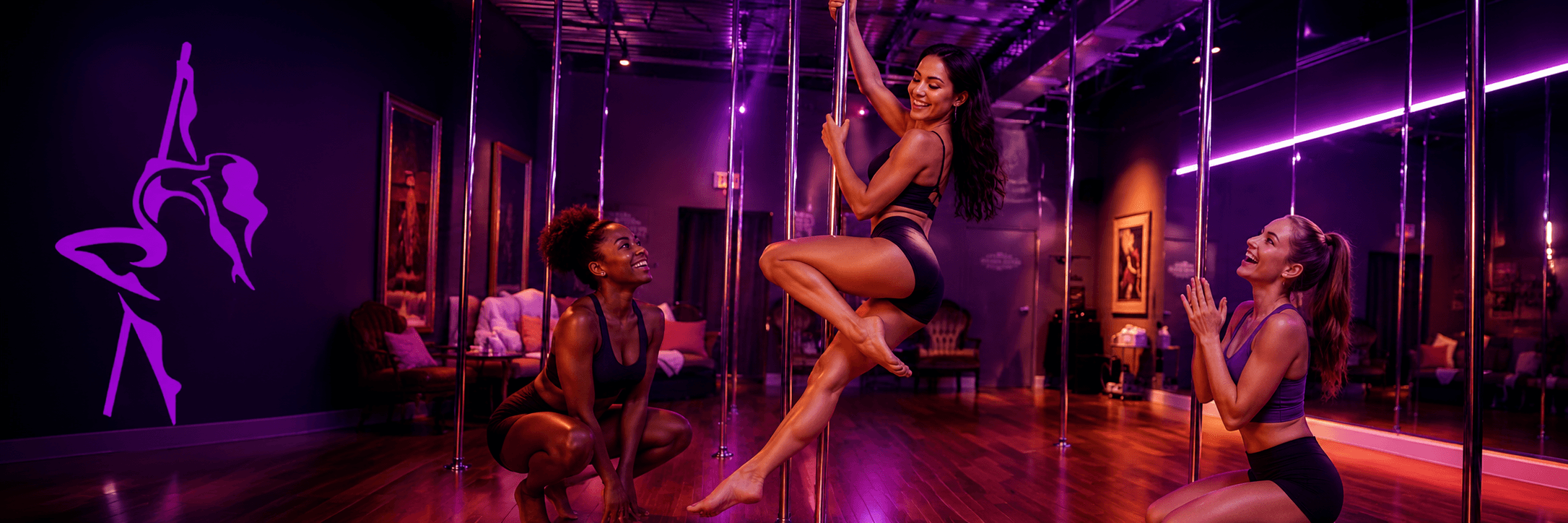
Pole Dancing vs Yoga for Strength and Flexibility | St. Pete
Pole dancing vs yoga for strength and flexibility — an honest comparison from a St. Pete studio that teaches complete beginners every week.
If strength is your priority, pole typically builds it faster than yoga — especially grip, back, and pulling strength — while yoga generally goes deeper on flexibility, and pole sits in the middle by training both in the same hour. That is the short, honest answer. If you are reading this in August 2026, you may be a woman somewhere in Tampa Bay who has done her share of vinyasa classes, feels reasonably bendy but still cannot pull herself up on anything, and is quietly wondering whether comparing pole dancing and yoga for strength and flexibility even makes sense when you have never touched a pole in your life. It does. And the comparison is more interesting than most fitness articles let on.
WHAT YOGA GENUINELY DOES BETTER
Let's give yoga its due, because it earns it. Yoga is one of the best practices in existence for flexibility, joint mobility, balance, and breath control. A consistent yoga practice lengthens tight hips and hamstrings, teaches you to hold positions under your own bodyweight, and builds a kind of quiet, patient body awareness that carries into everything else you do. It is also low-impact, widely available, and easy to practice at home with nothing but a mat.
If your single goal is to touch your toes, calm your nervous system, or move through your day with less stiffness, yoga is a genuinely excellent choice. Nothing in this post argues otherwise.
Where yoga has a limit is in the type of strength it builds. Most yoga postures are pushing and holding movements — planks, downward dog, arm balances. Yoga rarely asks you to pull your own bodyweight, and pulling strength is exactly what most women lack. Chaturanga will build your shoulders. It will not teach your back, biceps, and grip to lift you.
WHERE POLE PULLS AHEAD ON STRENGTH
Pole is, at its core, a pulling discipline. From your very first spin, you are gripping the pole and asking your hands, forearms, lats, and core to control your own bodyweight in motion. That is a demand yoga almost never makes, and it is why women who come to pole from years of yoga are often surprised at how quickly their arms and back change.
The strength gap for women is not a small thing. According to the CDC's National Center for Health Statistics, in 2020, 28.3% of men and 20.4% of women met the guidelines for both aerobic and muscle-strengthening activities. Women, as a group, under-train strength — and pole closes that gap almost by accident, because the strength work is disguised as learning a spin or a climb.
Pole also trains flexibility, just differently than yoga does. Every class at Intice includes a real warm-up and stretch work, and the studio keeps stretch bands, straps, and foam rollers on hand for exactly that purpose. As you progress, the moves themselves demand flexibility — hip openers for leg hooks, shoulder mobility for holds — so your stretching has a visible purpose. Many women stretch more consistently for pole than they ever did on a yoga mat, simply because they can see what the flexibility is for.
POLE DANCING VS YOGA FOR STRENGTH AND FLEXIBILITY WHICH SHOULD YOU CHOOSE?
Here is the fair breakdown. Choose yoga if flexibility, stillness, and stress relief are your main goals and building visible upper-body strength is not a priority. Choose pole if you want strength you can feel — the ability to grip, pull, and hold your own body — along with flexibility work built into every session, plus a cardio element yoga mostly lacks.
And honestly, many women do both. Yoga on your rest days makes you a better pole student. The hip and shoulder mobility you build on a mat shows up directly in your spins and holds. This is not a rivalry; it is a question of which one you build your week around. If strength and flexibility together are the goal, pole tends to be the more efficient anchor, with yoga as a beautiful supplement.
One more difference worth naming: progression. Yoga deepens over years in subtle ways. Pole gives you concrete, checkable milestones. At Intice, most students are spinning on their own within their first one or two classes, and most complete basic combinations within four to six weeks of regular attendance. That visible progress is what keeps a lot of women showing up when motivation dips.
BUT I HAVE NEVER BEEN STRONG OR FLEXIBLE IN MY LIFE
This is the fear underneath the search, so let's handle it directly. You do not need existing strength to start pole, and you do not need existing flexibility either. Level 1 classes assume nothing. The first spins use momentum and technique, not muscle, and the strength arrives as a result of the classes — it is not a prerequisite for them. If tight hamstrings are your worry, you are in good company; we wrote a whole post on whether you can pole dance if you are not flexible, and the short answer is yes.
Most women who walk into Intice have no dance background and no fitness background at all. The level system runs from Level 1 through Level 3+, and most students move from Level 1 to Level 1.5 after about eight to ten classes. Nobody is expected to arrive ready.
WHAT TRYING POLE IN TAMPA BAY ACTUALLY LOOKS LIKE
If you want to test this comparison on your own body instead of taking anyone's word for it, the barrier is low. Intice Dance Fitness sits at 2104 34th St S in St. Petersburg — same plaza as Domino's Pizza, opposite end — with parking, lockers, changing rooms, a water station, and mats provided. New students get two weeks of unlimited classes for $59, which is enough time to feel the difference between how yoga works your body and how pole does. Beyond pole, the full class lineup includes twerk, heels, chair dance, and specialty classes, so your two weeks can be a genuine sampler.
Wear form-fitting shorts and a sports top, come barefoot, skip the jewelry, and do not use lotion on class day — your skin is your grip.
KEY TAKEAWAY: Yoga is the deeper flexibility practice; pole is the stronger strength builder, particularly for the pulling strength most women never train — and because pole includes stretch work in every class, it covers more of the strength-and-flexibility picture in a single hour.
If your yoga mat has taught you patience but not pulling strength, it might be time to see what a pole class does differently. Browse the current class times and book your first session here — no experience needed, ever.
FAQ
Q: Can I keep doing yoga while I learn pole?
A: Absolutely, and many students do. Yoga on your off days improves the hip and shoulder mobility that pole moves demand, while pole builds the pulling strength yoga rarely trains. The two complement each other better than almost any other pairing.
Q: Which one will change how my body looks faster?
A: Every body responds differently, so no honest studio promises a timeline. That said, pole tends to produce noticeable strength changes in the arms, back, and core because it loads those muscles with your full bodyweight, while yoga changes tend to show up more in posture and range of motion.
Q: Do beginner pole classes near St. Pete assume I already have yoga-level flexibility?
A: Not at all. Women from all over Pinellas County walk into Level 1 stiff from desk jobs, long commutes, and years without stretching, and the class is built for exactly that starting point. Warm-ups, guided stretching, and props like bands and straps are part of every session, so your flexibility develops alongside your strength rather than being required up front.
You Might Also Like