
Pole Dancing vs Yoga for Flexibility | St. Petersburg, FL
Pole dancing vs yoga for flexibility: what each really does for tight hips and hamstrings, and how women in St. Petersburg decide between them.
You cannot touch your toes anymore. Maybe you never could. You sit at a desk most of the day, your hips feel like rusted hinges, and every time you try to stretch on the living room floor you last about four minutes before you get bored and check your phone. So now, in August 2026, you are comparing pole dancing and yoga, trying to figure out which one would actually make your body feel looser. Plenty of women across Tampa Bay end up asking this exact question, and the honest answer is more interesting than a simple winner-and-loser verdict. Both work. They just work differently, and the difference matters depending on who you are.
WHAT YOGA GENUINELY DOES WELL
Let's give yoga its due, because it has earned it. Yoga is one of the most reliable ways to build flexibility that exists. A good yoga practice takes you through long, held stretches for the hips, hamstrings, spine, and shoulders, paired with breathing that helps your nervous system relax enough to let the muscles lengthen. That last part is not fluff. A lot of tightness is your body guarding itself, and yoga is exceptionally good at teaching it to stop.
Yoga is also low-impact, widely available, easy to practice at home, and gentle on beginners. If your main goal is stress relief plus gradual flexibility, and you genuinely enjoy quiet, meditative movement, yoga may be exactly right for you. Nothing in this post argues otherwise.
The catch is the word "enjoy." Yoga only builds flexibility if you keep showing up, and many women quietly admit they find it hard to stay motivated in a class where progress is subtle and the format rarely changes. If you have started and abandoned yoga twice already, the problem may not be discipline. It may be that you need a reason to stretch beyond stretching itself.
POLE DANCING VS YOGA FOR FLEXIBILITY WHERE THE DIFFERENCE SHOWS UP
Here is the core distinction. Yoga primarily trains passive and static flexibility: your ability to relax into a stretch and hold it. Pole trains what coaches call active flexibility: your ability to move into a range of motion and control it while you are doing something with it.
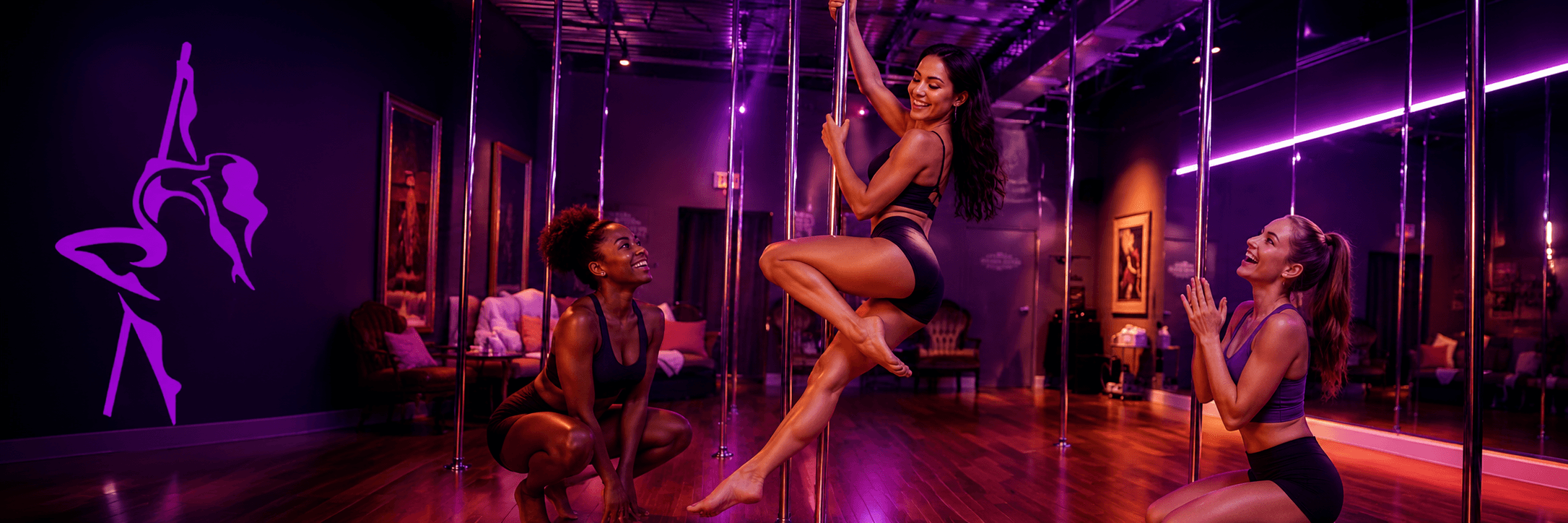
In a pole class, flexibility is never the whole point, which is exactly why it sneaks up on you. Every class starts with a full warm-up and stretch, and then the moves themselves demand range. Spins open the shoulders. Floorwork and low-flow movement work the hips and inner thighs. Climbs and leg hooks stretch the hamstrings while the muscles around them are working. Over weeks, your body stops treating those ranges as foreign territory because you are using them, not just visiting them.
The other difference is motivation. In yoga, the stretch is the goal. In pole, the stretch is the ticket to a move you want. When you find out that a cleaner leg extension is what stands between you and the spin you have been eyeing, you suddenly care about your hamstrings in a way no folded-forward pose ever made you care. Women who could never stick with a stretching routine often stretch at home for the first time in their lives because pole gave them a reason.
If you are worried you are too stiff to even start, that fear is common and almost always backwards. We wrote a full breakdown on this in can you do pole dancing if you're not flexible, but the short version is that flexibility is something pole builds, not something it requires.
THE STRENGTH PIECE YOGA MOSTLY LEAVES OUT
There is a second half to flexibility that rarely gets discussed: strength at the end of your range. A hip that can stretch open but has no strength there is a hip that will tighten right back up, because your body does not trust ranges it cannot control. This is where pole pulls ahead for many women. Every stretch you gain on the pole comes packaged with the grip, core, and back strength to use it.
That combination matters more than most people realize. The CDC's guidance is clear that adults need at least 150 minutes a week of moderate-intensity activity and at least 2 days a week of activities that strengthen muscles. Gentle yoga covers some of the first requirement and very little of the second. Pole covers both in the same hour, which is a practical win for anyone whose schedule does not have room for two separate disciplines.
WHAT FLEXIBILITY TRAINING LOOKS LIKE AT OUR ST PETE STUDIO
At Intice, flexibility work is baked into everything rather than bolted on. Classes run from Level 1 through Level 3+, and every level includes guided warm-ups and cool-down stretching, with stretch bands, straps, and foam rollers available in the studio so you can work on tight spots before or after class. Most students are spinning on their own within their first one to two classes, and most complete basic combinations within four to six weeks of regular attendance, gaining noticeable range along the way. Students who come two to three times a week progress noticeably faster than those who come once.
You also do not have to choose pole alone. Our class offerings include pole fitness, twerk, heels, chair dance, and specialty formats, so you can mix styles that challenge your body in different ranges. Most of the women who walk through our doors arrive with no dance or fitness background at all, which means our instructors are used to bodies that have not stretched properly in years.
SO WHICH ONE SHOULD YOU ACTUALLY PICK
If you love stillness, breathwork, and a meditative pace, choose yoga and go regularly. If you have tried stretching-for-its-own-sake and could not stay interested, choose pole, because it delivers flexibility as a side effect of something you will actually look forward to. And if you can do both, do both. Yoga's long holds and pole's active range work complement each other beautifully, and plenty of our students keep a mat practice alongside their pole classes.
The worst option is the one you quit. Pick the room you will keep walking into.
KEY TAKEAWAY: Yoga builds flexibility through long passive stretches, while pole builds active, usable flexibility plus the strength to control it. For women who get bored stretching, pole tends to be the version they actually stick with.
If you are curious what a first class feels like, our intro offer gives new students two weeks of unlimited classes for $59, so you can test the difference in your own hips and hamstrings. Grab a spot on our schedule page and come see for yourself.
FAQ
Q: Do I need to be flexible before my first pole class?
A: No. Beginner classes assume no flexibility, no strength, and no dance background. Every class includes a guided warm-up and stretch, and instructors modify moves for whatever range your body has right now.
Q: Can I do yoga and pole at the same time?
A: Yes, and they pair well. Yoga's passive stretching helps you recover and relax between pole classes, while pole builds the strength to control the range yoga opens up. Many students keep both.
Q: Where do women in the St. Pete area take pole classes?
A: Intice Dance Fitness is located at 2104 34th St S, in the same plaza as Domino's Pizza at the opposite end, with parking, changing rooms, lockers, and a water station on site. The studio is open Monday through Sunday, 6am to 10pm, and drop-ins are always welcome, so check the schedule page for current class times.
You Might Also Like