
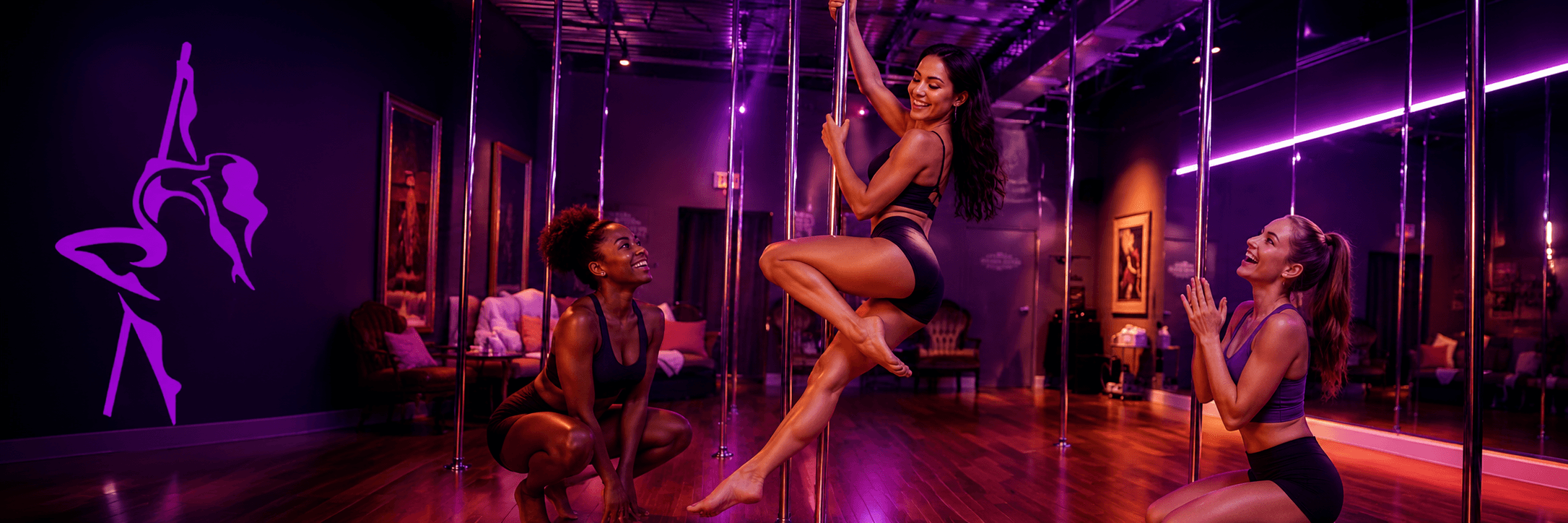
Pole Dancing vs Yoga for Flexibility | St. Petersburg, FL
Pole dancing vs yoga for flexibility: what each really does for tight hips and hamstrings, and which one fits you best in St. Petersburg, FL.
You cannot touch your toes. Your hips feel like they were poured in concrete, your lower back complains when you sit too long, and you have decided that this is the season you finally do something about it. Now it is August 2026, you are comparing pole dancing and yoga for flexibility, and you are not sure which one a stiff, ordinary woman in Tampa Bay should actually pick. Maybe yoga feels like the obvious answer and pole feels like the one you secretly want. Both instincts are worth listening to. Let's compare them honestly.
WHAT YOGA ACTUALLY DOES FOR A STIFF BODY
Yoga deserves its reputation. A good yoga class spends sustained, focused time in stretches — long holds in pigeon pose for your hips, forward folds for your hamstrings, gentle backbends for a spine that spends all day hunched over a desk. That kind of patient, repeated exposure is exactly how tight tissue learns to lengthen.
Yoga also teaches you to breathe through discomfort, which matters more for flexibility than most people realize. A tight muscle held by a tense, breath-holding person does not release. Yoga trains the calm that lets stretching work.
If your only goal is to stretch more, more often, with excellent guidance, yoga does that very well. No fair comparison should pretend otherwise.
WHAT POLE DOES DIFFERENTLY WHEN YOU WANT TO GET BENDY
Pole approaches flexibility from the opposite direction: it gives you a reason to want it.
In yoga, flexibility is the practice itself. In pole, flexibility is the key that opens doors. The first time you see a move that requires a deeper hip opening or a straighter split line, stretching stops being a chore and becomes preparation for something you are excited about. Students who never stretched a day in their lives suddenly ask instructors for hamstring drills, because they want a specific shape on the pole.
Pole classes also build what is called active flexibility — the ability to hold your leg in a lifted, extended position using your own muscles, not just fold into a passive stretch on the floor. Yoga develops range; pole demands that you control that range while gripping, spinning, and moving. Warm-ups in a pole class include dynamic stretching, and many students use the studio's stretch bands, straps, and foam rollers before and after class to work on their splits and shoulder mobility between combinations.
And you do not need to arrive flexible. Most women who walk into a Level 1 class cannot touch their toes either. If that worry is what is holding you back, this honest look at whether you can pole dance if you are not flexible will put your mind at ease.
WHY STRENGTH IS THE MISSING PIECE MOST STRETCHING SKIPS
Here is the part of the comparison almost nobody mentions: flexibility without strength tends to stall.
Your nervous system limits how far a muscle will lengthen partly based on whether you can control that range. Build strength around a joint and the body often allows more movement, because it trusts you there. This is why pole students frequently gain flexibility faster than they expect — every spin, climb, and hold is strengthening the exact muscles that surround their tightest areas.
It also matters for your health beyond the splits. The CDC states that adults need at least 150 minutes a week of moderate-intensity activity and at least 2 days a week of activities that strengthen muscles. A gentle yoga practice may or may not check the strength box depending on the style. A pole class checks it every single time, because you are lifting and holding your own body weight from the first session — and most students are spinning on their own within their first one or two classes.
POLE DANCING VS YOGA FOR FLEXIBILITY WHICH ONE SHOULD YOU PICK?
If you want a quiet, meditative practice built entirely around stretching and breath, yoga is the more direct route, and nothing in a pole studio replaces that.
If you struggle to stay consistent with stretching because it bores you, pole tends to win — not because pole stretches you more per minute, but because you keep showing up. Consistency beats intensity in flexibility training every time, and it is much easier to be consistent with something that makes you laugh, gives you a new trick to chase, and leaves you feeling like a different woman than the one who walked in.
The honest answer for many women is both. Plenty of pole students keep a yoga habit on the side, and their pole progress benefits from it. But if you have to choose one place to start, choose the one you will still be attending in six months.
TRYING BOTH SIDES OF THIS IN TAMPA BAY WITHOUT A BIG COMMITMENT
You do not have to decide from your couch. Intice Dance Fitness sits at 2104 34th St S in the same plaza as Domino's Pizza, at the opposite end, and the studio is open Monday through Sunday, 6am to 10pm — check the schedule page for actual class times, since specific classes run at specific hours. Classes run from Level 1 through Level 3+, alongside twerk, heels, and chair dance if you want variety, and you can see the full range of class types on the services page.
New students get 2 weeks unlimited for $59, which is enough time to take several beginner pole classes, use the stretch bands and foam rollers, and feel for yourself whether this approach to flexibility suits your body better than a mat and a quiet room. Wear form-fitting shorts and a sports top, come with bare feet, skip the jewelry, and do not apply lotion on class day — dry skin grips the pole.
KEY TAKEAWAY: Yoga stretches you more directly, but pole builds the strength that makes flexibility stick — and gives you a reason to keep stretching. The best choice is whichever one you will actually attend week after week.
If your hips and hamstrings have waited this long, they can handle one beginner class to find out. Grab a spot on the Intice schedule and come stretch with us.
FAQ
Q: Do I need any flexibility at all before my first pole class?
A: No. Level 1 classes assume you cannot touch your toes, and every warm-up includes stretching appropriate for beginners. Flexibility is something you build in class, not a requirement to enter it.
Q: Will pole alone make me flexible, or do I still need to stretch separately?
A: Pole warm-ups and cool-downs include stretching, and many students see real gains from class alone. If you want faster progress toward a specific goal like the splits, adding short stretch sessions at home or before class with the studio's bands and straps will speed things up.
Q: I live in Tampa Bay but not right in St. Pete — is the drive worth it for flexibility work?
A: Many of our students drive in from surrounding towns because consistent, guided classes beat sporadic stretching at home, and the studio's long daily hours make it easier to fit a class around a commute. With parking on site and lockers, changing rooms, and a water station inside, the visit is simple even on a workday.
You Might Also Like