
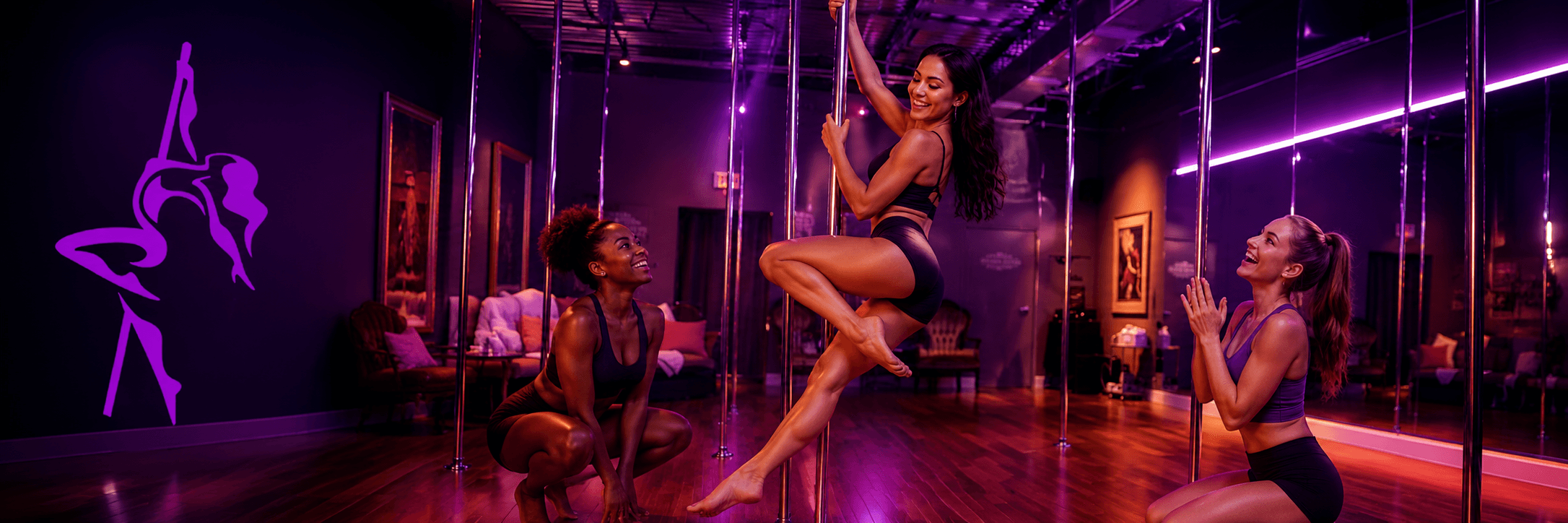
What Is a Pole Trick vs a Pole Spin vs a Pole Combo?
What is a pole trick vs a pole spin vs a pole combo? A clear instructor's guide to three terms every beginner hears in class.
A pole spin is a move where your body rotates around the pole, a pole trick is a shape or hold you perform on the pole, and a pole combo is two or more moves linked into one continuous sequence. That is the short answer to what is a pole trick vs a pole spin vs a pole combo, and as of November 2026 it is still one of the first questions new students ask me. All three exist at every level, from a first class to advanced training. Knowing the difference helps you follow along in class and understand what you are watching online.
WHAT IS A POLE TRICK VS A POLE SPIN VS A POLE COMBO?
A spin is about rotation. You usually start standing, hold the pole with your hands, and use a step and a little momentum to carry your body around the pole before landing on your feet again. The fireman spin and chair spin are classic examples. What you see is travel: the dancer circles the pole.
A trick is about shape. The dancer gets into a position on the pole and holds it, using skin contact, grip, and strength to stay there. A pole sit is a trick. So are the poses built from a climb, and so are the upside-down shapes you see in videos. What you see is stillness, or a slow, controlled pose.
A combo, short for combination, is about connection. It is any sequence where one move flows into the next without stopping to reset. The moves inside it can be spins, tricks, floor movement, or a mix. If a spin is a word, a combo is a sentence.
One caution on terminology: usage varies. Some dancers say "trick" loosely for any named move, spins included. If a term is used differently in your class, ask.
WHICH LEVEL DOES EACH ONE BELONG TO?
These are categories, not single moves, so none of them sits at one level. There are beginner spins and advanced spins, and beginner tricks and advanced tricks.
In general terms, beginners usually meet spins first, along with grounded tricks that keep you upright and close to the floor. Most of our students are spinning on their own within their first 1-2 classes. Tricks that take you higher up the pole are generally intermediate. Anything inverted or aerial is intermediate to advanced and rests on a solid base of climbing, grip, and core strength.
Combos scale with their ingredients. A combo is only as demanding as the hardest move inside it, plus the transitions between moves. Most students complete basic combinations within 4-6 weeks of regular attendance, though every body moves at its own pace.
Ask your instructor where a specific move falls in the Level 1 through Level 3+ progression. You can also see how classes are organized on our class types and levels page.
WHAT DOES EACH ONE BUILD IN YOUR BODY?
Spins train grip, shoulder engagement, timing, and coordination. The real skill is learning to control momentum instead of being thrown by it.
Tricks train static strength and body awareness. Holding a shape asks your muscles to work without movement to help, and it teaches your skin to tolerate contact with the pole.
Combos train stamina, memory, and confidence. Linking moves means you keep working when your grip is already a little tired, and you have to think one step ahead.
A 2016 study of 52 fitness pole dancers found that hand-grip strength and postural stability increased significantly with pole dance experience level. It was a small, observational study, but it fits what instructors see: grip and balance develop gradually through regular practice of all three categories. If you are curious about pacing, we wrote about how long it takes to learn pole dancing in a separate post.
WHAT DO BEGINNERS GET WRONG ABOUT THESE TERMS?
The first misconception is that tricks are the "real" pole and spins are just a warm-up. A clean, controlled spin with good lines is a skill in its own right, and advanced dancers keep refining theirs.
The second is that combos are only for advanced students. A combo can be two beginner moves joined smoothly. The linking is the skill.
The third is a mix-up between a spin and a spin pole. A spin is a move your body does. A spin pole is a piece of equipment that rotates. They are related, but they are not the same thing.
The fourth matters most for safety. Many people assume that watching a trick closely enough means they can try it. The inverted and aerial tricks that look effortless online rest on a great deal of conditioning you cannot see in a short clip. Those moves must be learned in person with a qualified instructor, with spotting and crash mats. They should never be attempted alone or at home.
HOW DO YOU LEARN ALL THREE SAFELY IN A CLASS?
At Intice Dance Fitness in St. Petersburg, spins, tricks, and combos are taught through progression. An instructor watches your grip and shoulder position, breaks each move into pieces, and links moves together only once the individual parts are steady.
For anything aerial or inverted, that means hands-on spotting, crash mats, and an instructor who decides with you when your body is ready. Enthusiasm alone does not set that timing.
A few things are normal early on. Skin discomfort and light bruising, often called pole kisses, are common in the first weeks as your skin adapts. Sharp pain is not something to push through. Stop and tell your instructor.
If you have an injury or a medical condition, check with a doctor before starting. A blog post can explain vocabulary, but it is not a substitute for instruction.
Drop-ins are always welcome, and no experience is needed. Wear form-fitting shorts and a sports top, and skip lotion on class day so your skin can grip the pole.
KEY TAKEAWAY: A spin rotates around the pole, a trick is a held shape on the pole, and a combo links moves together. All three are learned safely in class with an instructor, never from a video alone.
If you want to feel the difference between a spin, a trick, and a combo in your own body, come learn them with an instructor beside you. Find a class that fits your week on our schedule page, and we will take it one move at a time.
FAQ
Q: Can I try pole spins or tricks at home after watching a video?
A: Learn them in a class first. An instructor can see your grip, shoulder position, and landing in ways you cannot check yourself. Inverted or aerial tricks should never be attempted alone or at home; they need a qualified instructor, spotting, and crash mats.
Q: Do I have to learn spins before tricks and combos?
A: Most beginners at Intice in St. Petersburg meet spins and grounded holds first, then start linking them into short combos. The exact order depends on the class and on your body. Ask your instructor where a move sits in the Level 1 through Level 3+ progression.
Q: Is a pole combo the same thing as a routine?
A: Not quite. A combo is a short sequence of linked moves, while a routine is a longer piece of choreography, usually set to music, that may contain several combos. Think of a combo as a sentence and a routine as the whole story.
You Might Also Like