
How to Start Pole Dancing With No Upper Body Strength | St. Pete
How to start pole dancing with no upper body strength in St. Pete — and why waiting until you feel "strong enough" is the slower path.
You cannot do a pull-up. Maybe not even a full push-up. And every time you think about trying a pole class, that fact stops you at the door. If you are anywhere in Tampa Bay this August 2026, sweating through another summer and wondering whether you need to get strong before you are allowed to start pole, this post is for you. There are two ways women in your exact position approach this, and they lead to very different places. Let's compare them honestly.
THE TWO PATHS WOMEN TAKE WHEN THEY FEEL TOO WEAK FOR POLE
Path one: prepare first. Spend a few months at the gym building upper body strength — lat pulldowns, assisted pull-ups, push-ups on your knees — and sign up for pole once you feel ready.
Path two: start now. Walk into a Level 1 class exactly as you are, with the arms you have today, and let pole itself build the strength.
Both paths are reasonable. Only one of them tends to actually get women on the pole. Here is how they stack up.
PATH ONE: GET STRONG AT THE GYM FIRST
To be fair to this approach: general strength training is genuinely valuable, and nothing about pole replaces the benefits of progressive resistance work. If you already love lifting, keep lifting. Rows, dead hangs, and push-up progressions will absolutely help your pole practice down the road.
But as a prerequisite for starting pole, this path has three problems.
First, gym strength and pole strength overlap less than you would think. Pole relies heavily on grip endurance, body positioning, and knowing how to use momentum and leverage — skills a lat pulldown machine cannot teach you. Women who arrive with gym backgrounds still start at Level 1, because the movement vocabulary is new to everyone.
Second, "ready" is a moving target. Most women who choose this path never actually book the pole class. There is no finish line where you suddenly feel strong enough, so the preparation phase quietly becomes permanent.
Third, there is a motivation gap. It is hard to grind through months of training for a goal you have never experienced. This matters more than most people admit. According to the CDC's National Center for Health Statistics, in 2020, 28.3% of men and 20.4% of women met the guidelines for both aerobic and muscle-strengthening activities. Women under-train strength as a group, and one of the biggest reasons is that traditional strength work feels like a chore. Pole gets around that by disguising the strength training inside something you actually want to do.
HOW TO START POLE DANCING WITH NO UPPER BODY STRENGTH TODAY
Now the second path — the one where you start before you feel ready.
Level 1 pole classes are built for the woman who cannot do a pull-up, because that describes most of the women who walk in. Nobody hands you an inversion on day one. Your first classes are spent learning to walk around the pole, transfer your weight, and use spins that run on momentum and body angle rather than raw arm power. A basic spin works because of where your hips and shoulders are, not because of how hard you can pull.
That is why most students at Intice are spinning on their own within their first one to two classes. Not because they got strong overnight, but because beginner spins were never a strength test in the first place.
The strength arrives on its own schedule, as a side effect. Gripping the pole builds your hands and forearms. Holding your frame during spins wakes up your shoulders and back. Controlling your descent works your core. Most students move from Level 1 to Level 1.5 after 8 to 10 classes, and most are putting together basic combinations within 4 to 6 weeks of regular attendance. Students who come 2 to 3 times a week progress noticeably faster than those who come once a week — not because they are stronger going in, but because the practice compounds.
If you are still doubting whether this is realistic for someone starting from zero, read is pole dancing hard to learn for beginners — it walks through exactly what the learning curve feels like.
WHAT YOUR FIRST WEEKS AT A ST. PETERSBURG STUDIO ACTUALLY LOOK LIKE
Here is the practical version of path two at Intice.
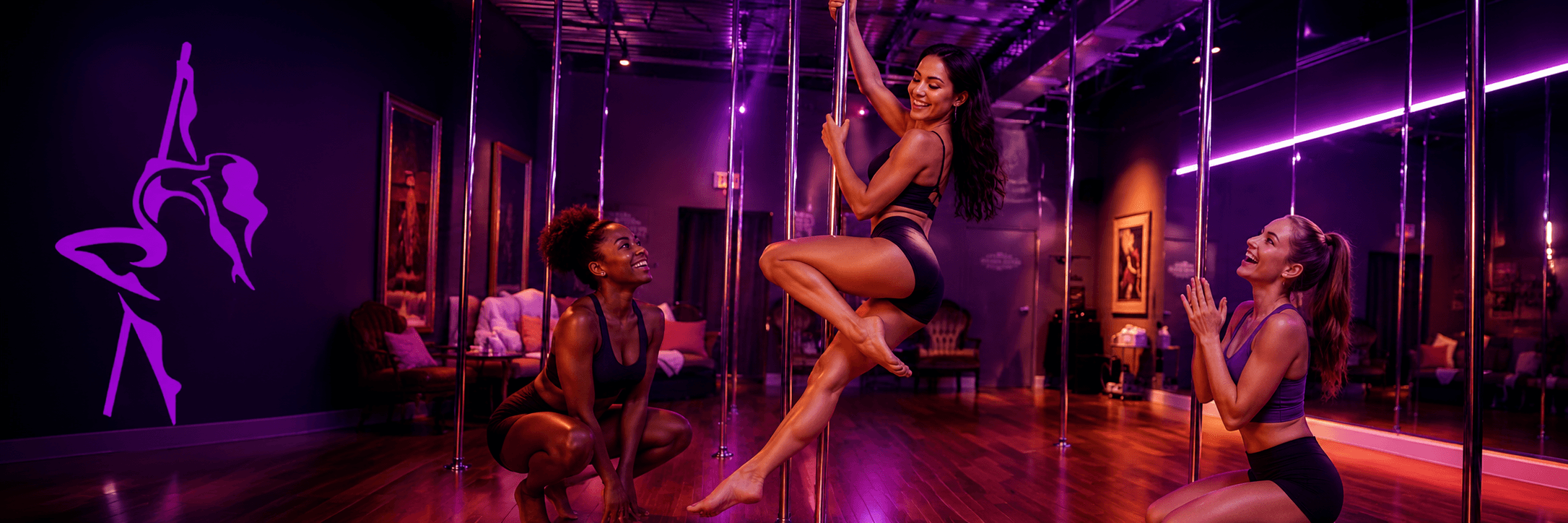
You book a Level 1 class — drop-ins are welcome and no experience is needed. You wear form-fitting shorts and a sports top, come in bare feet, skip the jewelry, and skip lotion on class day, because skin is what grips the pole. Mats are provided, there is a water station, fans keep the room bearable in summer, and there are changing rooms and lockers so you can come straight from work.
New students get 2 weeks unlimited for $59, which is the smartest way to test this path. Two weeks at 2 to 3 classes a week is enough to feel your grip improving and to land your first spins — real evidence, from your own body, that you did not need to be strong first. Instructors modify everything, so if a move loads your wrists or shoulders more than you can handle today, there is a regression for it. If you have lingering questions before you book, the FAQs page covers the common ones.
SO WHICH PATH ACTUALLY GETS YOU THERE FASTER
Path one builds general strength but delays the skill, and often delays it forever. Path two builds the skill and the strength at the same time, because pole is itself the strength program — one that happens to be specific to exactly the movements you are trying to learn.
The pole builds the strength the pole requires. No gym program prepares you for it as efficiently as simply doing it, scaled to your current body, a couple of times a week. The only real prerequisite is showing up.
KEY TAKEAWAY: You do not need upper body strength to start pole — you need pole to build your upper body strength. Beginner classes are designed around momentum and technique, and the strength develops as a byproduct of consistent attendance.
If you have been waiting to feel ready, consider this your permission slip to skip the waiting. Grab the 2-week intro and book your first Level 1 class — bring the arms you have, and let them catch up on the pole.
FAQ
Q: I can't hold my own body weight at all. Will I just hang there embarrassed?
A: No, because Level 1 never asks you to hold your full body weight with your arms alone. Your feet stay involved, spins use momentum, and instructors give you a regression for anything that feels beyond you. Struggling a little is normal — everyone in the room started there.
Q: How long until I actually feel stronger?
A: Most women notice grip and forearm changes within their first few weeks, especially attending 2 to 3 classes weekly. Bigger changes, like controlling spins with your back and core, tend to show up over the first couple of months of consistent classes.
Q: Where do beginners in the Pinellas County area train, and is parking easy?
A: Intice Dance Fitness is at 2104 34th St S — in the same plaza as Domino's Pizza, at the opposite end — with free parking right outside. The studio is open Monday through Sunday, 6am to 10pm, and the schedule page lists exact class times so you can find a Level 1 slot that fits your week.
You Might Also Like