
Spin Pole vs Static Pole Which Should Beginners Learn First
Spin pole vs static pole which should beginners learn first? An instructor compares both modes and explains where new students usually start.
A static pole is fixed in place so you travel around it, while a spin pole rotates so the pole turns with you, and many beginners do well starting on static before adding spin. If you typed spin pole vs static pole which should beginners learn first into a search bar in November 2026, you probably saw a dancer floating through endless rotations online and wondered where a new student begins. Both modes belong in a well-rounded dancer's training. They simply ask different things of your body.
WHAT IS THE DIFFERENCE BETWEEN A SPIN POLE AND A STATIC POLE
On a static pole, the pole does not move. Every bit of rotation comes from you: the step you take, the momentum you create, and the way you push and pull through your arms. Static spins have a clear beginning and a clear end. You lift off, travel around, and land.
On a spin pole, the pole itself rotates. Once your feet leave the floor, it keeps turning with you on it. Pulling your body in close to the pole speeds the rotation up, and extending your limbs away from it slows the rotation down.
Many studio poles can switch between the two modes with a locking mechanism, so the same pole is often both.
Visually, static tends to look grounded and rhythmic, with strong dance transitions between moves. Spin looks continuous and floaty, which is why it shows up so often on social media.
SPIN POLE VS STATIC POLE WHICH SHOULD BEGINNERS LEARN FIRST
Many instructors introduce static first, and I agree with that approach for most new students. A static pole is predictable. It stays where you left it, your feet come back to the floor quickly, and you learn how to create and control your own momentum.
Spin mode is not strictly an advanced skill, and some beginner-friendly shapes are taught on it. What it demands is control. The pole keeps moving after you leave the floor, so you need enough grip endurance and body awareness to stay with it and step off calmly.
A few things typically come before spin work:
- A comfortable, secure grip
- Walking around the pole with good posture
- A few fundamental spins on static
- The ability to hold your own weight for a short moment
Ask your instructor where spin mode falls in the Level 1 through Level 3+ progression, because that depends on the class and on you. For context, most of our students are spinning on their own within their first 1-2 classes.
WHAT DOES EACH MODE BUILD IN YOUR BODY
Static trains you to produce movement. You learn timing, coordination, and how to push with one arm while pulling with the other. It also teaches engaged shoulders and clean entries and exits, which carry into everything else in pole.
Spin trains you to sustain movement. Because the rotation continues, you hold shapes longer, and that asks more of your grip, your core, and your patience. It also builds a feel for speed control and a gradual tolerance for rotation.
Both modes reward consistent practice. A small observational study of 52 fitness pole dancers found that hand-grip strength and postural stability increased significantly with pole dance experience level. If you are wondering whether your current strength is enough to begin, this post on whether pole dancing is hard to learn for beginners answers that honestly.
WHAT DO BEGINNERS GET WRONG ABOUT SPIN AND STATIC
Misconception one: the spin pole does the work for you. It provides the rotation, but you provide the hold. Staying on a moving pole usually feels more demanding than new students expect.
Misconception two: static is only for beginners. Experienced dancers train on static throughout their pole lives because it demands power and control, and it shows every shortcut.
Misconception three: getting dizzy means spin is not for you. Dizziness on spin is very common early on. Many dancers find it settles with gradual exposure, and a good instructor will build in pauses.
A few general form cues apply to both modes:
- Keep your shoulders drawn down and away from your ears. Do not hang loosely from your joints.
- On spin, use a gentle entry. A big push creates more speed than a new dancer can manage.
- Keep a soft gaze on something close, such as your hand or the pole, to help with dizziness.
- Step off and take a breath whenever the room starts to move.
These cues describe the general idea. They do not replace an instructor watching your body in real time.
A few safety notes apply in either mode:
- Stop if you feel sharp pain.
- Skin discomfort and light bruising, often called pole kisses, are common in the early weeks.
- If you have an injury or a medical condition, check with your doctor before you start.
HOW DO YOU LEARN BOTH MODES SAFELY IN A CLASS
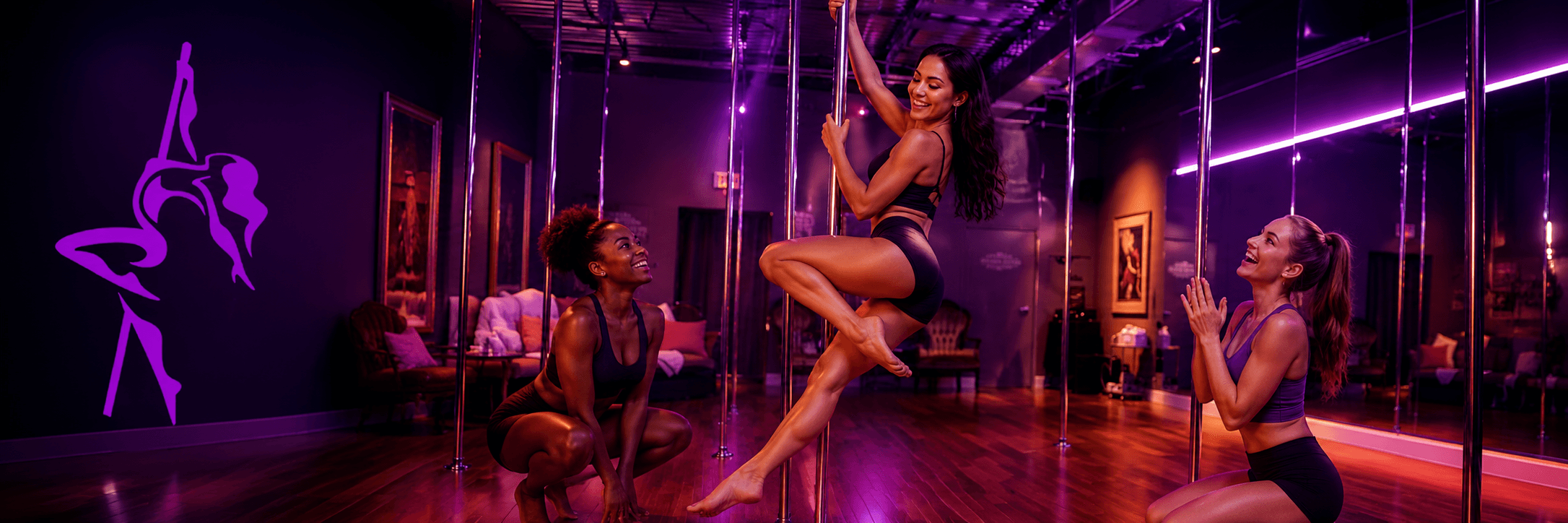
At Intice Dance Fitness in St. Petersburg, new students learn with an instructor who demonstrates each skill, watches your grip and shoulder position, spots when needed, and decides when you are ready for more. That progression matters more than which mode you touch first.
You can see the class types and levels we offer and ask your instructor which mode a given class will use. Drop-ins are always welcome, and no experience is needed.
Come prepared so your grip can do its job:
- Form-fitting shorts and a sports top
- Bare feet
- No jewelry
- No lotion on class day, since skin contact with the pole is what creates grip
Students attending 2-3 classes per week progress noticeably faster than those attending once a week, in either mode.
KEY TAKEAWAY: Static teaches you to create and control momentum, and spin teaches you to sustain it, so most beginners benefit from a static foundation first. Both modes are learned safely in class, with an instructor guiding your progression.
Come feel the difference between the two modes with an instructor right beside you. Find a class that fits your week on our schedule page, and we will take care of the rest.
FAQ
Q: Can I try a spin pole at home before taking a class?
A: I recommend learning in class first. A spinning pole keeps moving after you leave the floor, and without an instructor watching your grip, your speed, and your exit, it is hard to know what you are doing wrong. A home pole also needs correct installation, which is another reason to start in a studio.
Q: Will I get dizzy on a spin pole?
A: Many beginners do, and it is nothing to be embarrassed about. Dizziness often lessens with gradual practice, a gentle entry, and regular pauses. If it feels severe or does not pass, stop and check with your doctor.
Q: Do I need experience to start learning at Intice in St. Petersburg?
A: No experience is needed, and drop-ins are always welcome. New students can use the intro offer of 2 weeks of unlimited classes for $59. Your instructor will tell you which mode to begin with and when you are ready to add the other.
You Might Also Like